
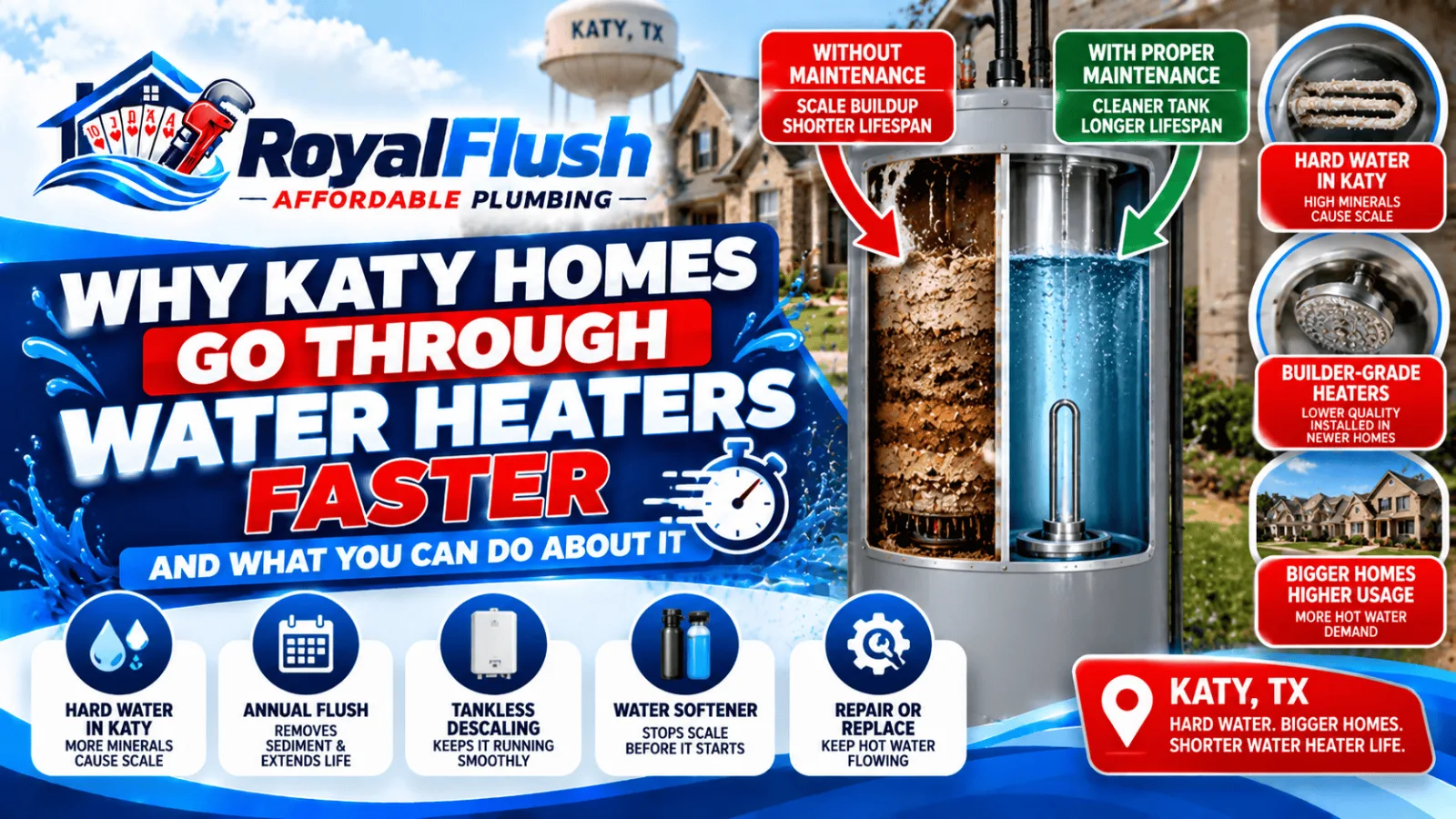
Plumbers who work both sides of the Grand Parkway notice it: water heaters in Katy, Cinco Ranch and the newer subdivisions west of Houston fail a few years earlier than the same models inside the Loop. The heaters are not worse. The water is harder, the houses are bigger, and the heaters were builder-grade to begin with. Here is what is happening inside the tank and what to do about it.
Katy's water is hard, with high levels of dissolved calcium and magnesium that drop out as scale when water is heated. In a tank heater the scale settles on the bottom and insulates the water from the burner, so the heater runs longer, rumbles, delivers less hot water and rusts out sooner; in a tankless unit it coats the heat exchanger and triggers error codes. An annual flush removes the sediment from a tank, annual descaling clears a tankless unit, and a whole-house softener stops the scale forming in the first place. Heaters in Katy that get none of those typically last six to nine years instead of ten to twelve.
- Hardness in the Katy area is well above the national average; scale forms every time water is heated.
- Rumbling, popping, less hot water and a longer recovery are a scaled tank talking.
- A yearly flush is the cheapest life extender there is; most builder-installed heaters never get one.
- Tankless units need annual descaling in Katy, and isolation valves to make it easy.
- A softener protects the heater, the dishwasher, the faucets and the glassware at once.
What hard water is, and what Katy's is like
Water hardness is the concentration of dissolved minerals, mainly calcium and magnesium, picked up from the rock and soil the water passes through. Much of the Katy area draws on groundwater from the Gulf Coast aquifer, which is naturally mineral-rich, and surface water blended in by regional authorities is not much softer. Water utilities serving Katy and the Fort Bend and Harris County MUDs commonly report hardness in the range that water treatment professionals classify as hard to very hard. The white spots on a shower door and the crust on a faucet aerator are the same minerals you cannot see inside the heater.
What scale does inside a tank heater
Heating water makes the minerals drop out of solution. In a tank, they settle as sediment on the bottom, directly on top of the surface the gas burner heats. The result is a layer of insulation between the flame and the water:
- The burner runs longer to reach temperature, which costs gas and stresses the tank.
- Water trapped under the sediment boils, which is the rumbling and popping sound, and the steam bursts flake the tank's glass lining.
- Hot water capacity drops because the sediment takes up tank volume; a 50-gallon tank with six inches of sediment behaves like a 40.
- The bottom of the tank corrodes faster where the lining is damaged, and the anode rod that protects it is used up sooner.
On an electric heater the lower element becomes buried in sediment and burns out, which is why lukewarm water is the common first symptom in electric homes.
What scale does inside a tankless heater
A tankless unit has no bottom to collect sediment; instead the minerals coat the narrow passages of the heat exchanger. Flow drops, the unit works harder to hit its temperature, and it starts showing error codes for flow or temperature. Left unflushed, a tankless unit in Katy can fail within a few years, which is unfair to a product that should last fifteen or twenty with care.
Why Katy homes are hit harder than average
- The water is harder than much of central Houston's surface-water supply.
- The homes are bigger, with 50- and 75-gallon tanks and higher hot water use, so more water is heated and more scale is made.
- Builder-grade heaters in large subdivisions are often the minimum specification, installed without a pan drain, without isolation valves on tankless units, and with no maintenance plan handed to the owner.
- Nobody flushes them. A heater installed when the house was built in 2014 has, in most cases, never been drained.
The signs a Katy heater is scaling up
- Rumbling, popping or crackling when the burner runs.
- Hot water that runs out sooner than it used to, or takes longer to come back.
- Lukewarm water in an electric home.
- Cloudy or rust-tinted hot water for the first few seconds.
- A tankless unit throwing flow or temperature error codes, or cycling on and off.
- A drain valve that releases sludge, or nothing at all because it is packed.
The three fixes, from cheapest to most complete
1. An annual flush (tank)
The heater is turned off, the cold inlet closed, a hose connected to the drain valve, and the tank drained until the water runs clear, then refilled. Done yearly from new, it keeps the sediment from ever building a layer. Done for the first time on a ten-year-old tank, it may release so much sediment that the drain valve clogs, and on a tank whose lining is already damaged it can reveal a leak; a plumber will tell you whether a first flush is wise or whether the tank should simply be replaced on a planned date.
2. Annual descaling (tankless)
A pump circulates a descaling solution through the heat exchanger for about an hour via the isolation valves below the unit, then flushes it clean. If the unit was installed without isolation valves, which is common in builder installations, they are added once and the job becomes routine after that.
3. A whole-house softener
A softener exchanges the calcium and magnesium for sodium or potassium before the water reaches anything. Scale stops forming in the heater, the dishwasher, the faucets and the shower doors. It is the one fix that addresses the cause, and in a hard-water area like Katy the heater life it buys, plus the appliance and fixture life, usually justifies it. It needs a drain, a power outlet and salt every month or two.
Repair or replace a scaled heater
If the tank is sound and under ten years old, flush it, replace the anode if spent, and set a reminder. If the tank is leaking from the body, rumbles despite flushing, or is past twelve years, replace it, and have the new one sized for the household and installed with a pan drain, a new shutoff and, if tankless, isolation valves. Then flush it every year. A replacement heater in Katy without a maintenance habit is simply the next failure on a timer.
Frequently asked questions
Is Katy water hard?
Yes. Water in the Katy area, much of it from the Gulf Coast aquifer, is classified as hard to very hard, which means scale forms whenever it is heated.
How often should I flush my water heater in Katy?
Once a year. In Katy's water that is the difference between a tank that lasts eight years and one that lasts twelve. Tankless units need annual descaling.
Why does my water heater make a rumbling noise?
Sediment on the bottom of the tank traps water that boils under it. The noise is the steam breaking through. It means the tank needs flushing and the lining may be wearing.
Does a water softener help a water heater?
Yes. It removes the minerals before they reach the heater, so scale does not form in the tank or the tankless heat exchanger. It also protects the dishwasher, washing machine, faucets and glassware.
How long do water heaters last in Katy?
Without maintenance, often six to nine years for a tank. With annual flushing, ten to twelve. Tankless units last longer still with annual descaling, and shorter without it.
Should I replace a builder-grade water heater early?
Not just because it is builder grade. Flush it, check the anode and the pan drain, and replace it when it leaks, rumbles despite flushing, or passes twelve years. A plumber can tell you how much life is left.


