
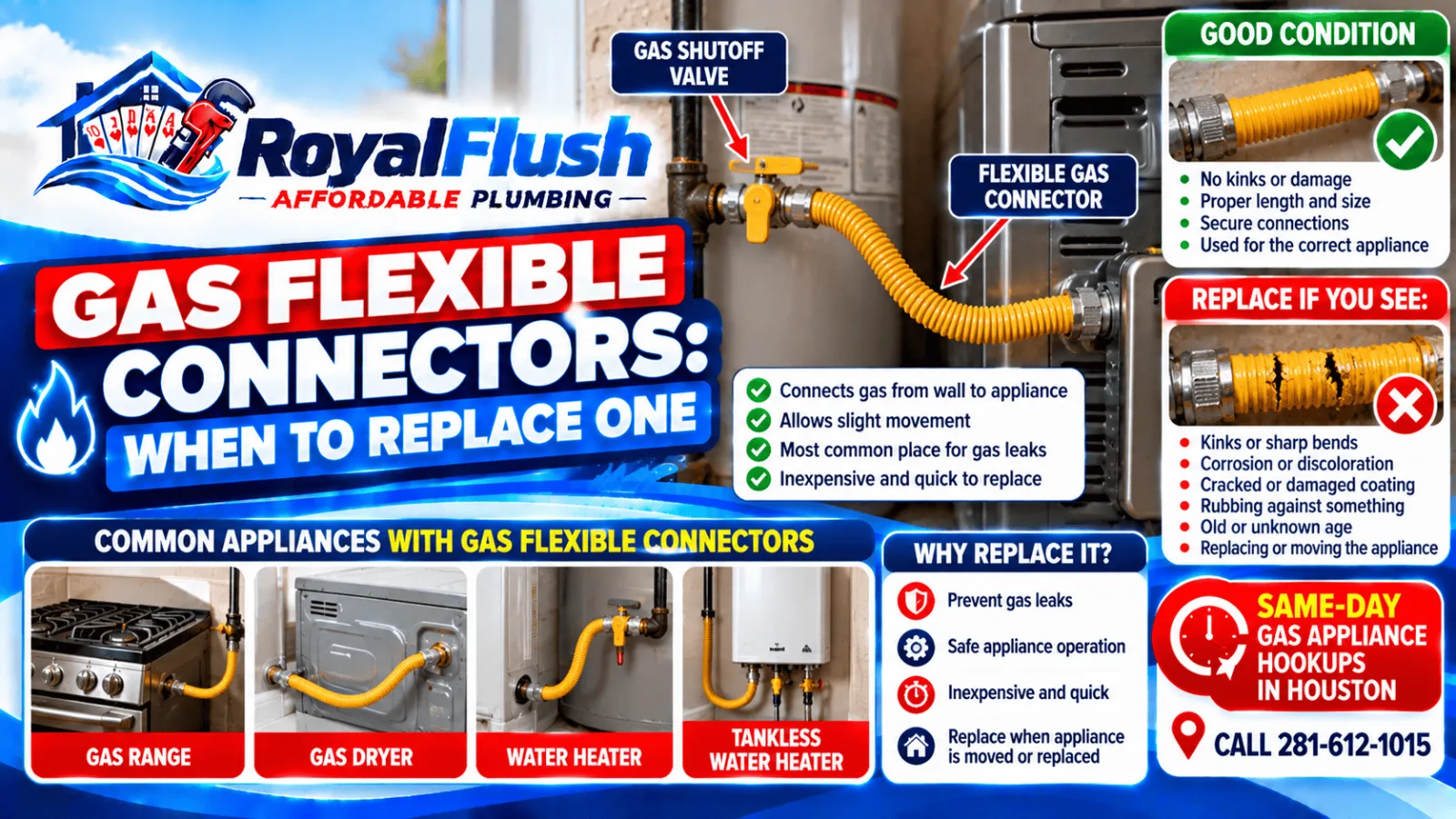
Behind every gas range, dryer and water heater is a short, bendy tube that most people have never looked at. It carries the gas from the pipe in the wall to the appliance, and it is the most common place for a small gas leak to start. It is also one of the cheapest and quickest things on a gas system to replace, which is why it is worth knowing when.
A flexible gas connector is the corrugated metal tube, usually yellow-coated or stainless, between the gas pipe and the appliance. Replace it when it is kinked, corroded, cracked or has a damaged coating, whenever the appliance is moved or replaced, and when it is of an unknown age or from a different appliance. Never reuse a connector on a new appliance. A new one is sized for the appliance, fitted with a shutoff valve at the wall and leak checked at the joints. If you smell gas, leave and call 911 or the gas utility first.
- A flexible connector is a wear item. It is bent, scraped, corroded and aged, and it is rated for one kind of appliance.
- Moving the appliance is the most common way a connector fails: it gets kinked, pulled or crushed when the range is pushed back.
- Never reuse a connector on a new or moved appliance. Replace it every time.
- Every gas appliance needs a shutoff valve within reach. If there is not one, adding it is part of the job.
- A small leak at a connector is a gas leak. Treat it as one.
What the connector is, and why it exists
Gas appliances cannot be connected with rigid pipe all the way. A range has to be pulled out to clean behind it, a dryer vibrates, and a water heater is moved a few inches when it is replaced. The flexible connector is the short section that lets the appliance move slightly while the gas piping in the wall stays fixed.
You can see one behind a gas range or dryer. It is a ribbed tube, often with a yellow coating, with a nut at each end: one to the shutoff valve on the wall pipe, the other to the appliance. On a water heater it is usually a short piece at the burner end. The photo on this page shows two gas water heaters with the yellow connectors visible and a shutoff valve at each.
Connectors come in different diameters and lengths, with different ratings. The size depends on how much gas the appliance burns. A range, a dryer and a tankless water heater do not use the same one. A connector that is too small restricts the gas, and one that is too long can sag and kink.
Signs that a connector needs replacing
- Kinks or sharp bends. A tube that has been folded or crushed behind a pushed-back range has a weak point. It may not leak today.
- Corrosion or discoloration. Green, white or rusty marks on the metal, or a coating that is flaking or cracked, mean moisture has got in. This is common in damp rooms and garages.
- Damaged coating. A cut or worn spot in the covering exposes the metal.
- Rubbing against something. A connector pressed against a sharp edge, the back of a range or a vibrating dryer wears through over time.
- Age or unknown history. If you do not know when it was installed, or it came with a house that was built a long time ago, treat it as old.
- A smell of gas near the appliance. This is the one that is urgent. Leave, and call 911 or your gas utility from outside. See our guide on what to do if you smell gas.
The rule: a new connector every time the appliance moves
The most common way a connector becomes a hazard is that someone moves the appliance and puts the old connector back on. It has been bent in a new direction, its fittings have been tightened and loosened, and it was never meant to be flexed repeatedly. It may look fine and leak at the first bend.
So the rule in the trade is simple: a new connector whenever an appliance is replaced, moved or serviced in a way that disturbs the connection. The same goes for the sealing at the threads. A fresh connection, tested, is cheap insurance.
It also matters which connector. A connector supplied with a new appliance is rated for that appliance. An old one from another appliance may be the wrong size, the wrong length or the wrong type.
The shutoff valve
The connector should come off a shutoff valve within reach of the appliance. It lets you stop the gas at that appliance without turning off the supply to the whole house, which matters if a connector fails, if you are moving the appliance, or when a plumber needs to work. It is a quarter-turn valve: when the handle is parallel to the pipe it is open, and when it is across the pipe it is closed.
If an appliance has no valve, or a valve that is stuck, hard to reach or hidden behind the appliance, add or replace it when the connector is changed. It is a short job and it is a finding on home inspections.
Checking for leaks
A connector can leak at the ends, where it screws on, or along the tube if the metal is damaged. Utilities and manufacturers commonly describe a soapy water test: brush or spray a solution of dish soap and water on each connection and look for bubbles forming. Do this only if you cannot smell gas. If you can smell gas, leave first.
Two cautions on that. A leak you cannot see or smell is still possible, and a connector that passes a soap test today may be weakened by a kink. When you are in doubt, have a licensed plumber check it. Do not use a flame to look for a leak, ever.
What a plumber does when replacing one
- Turns the gas off at the shutoff valve, or at the meter if the valve is missing.
- Disconnects the old connector and checks the shutoff valve and the pipe threads.
- Installs a new connector sized and rated for the appliance, with the right sealant for gas on the threads.
- Checks that the connection is not under strain, kinked or touching anything sharp.
- Turns the gas on slowly and checks every joint for leaks.
- Relights or restarts the appliance as the manufacturer instructs, and checks that it runs correctly.
- Shows you where the shutoff valve is.
If the connection is not a simple replacement, for example the pipe is corroded, the valve will not close or the line is too small, that is gas piping work. See our gas line repair page. Royal Flush Affordable Plumbing does this work under Texas Responsible Master Plumber License RMPL #42403.
Questions to ask before you buy a new appliance
- Is it a natural gas model? Some are sold for propane and need conversion.
- What size connector does it need, and does it come with one?
- Is there a gas shutoff valve at the spot, and is it reachable?
- Does the pipe at the wall have the capacity for the new appliance, especially a tankless water heater?
- Does the delivery crew connect gas, or only the electrical and water side? Many do not.
Frequently asked questions
How long does a flexible gas connector last?
There is no single number. It depends on the connector, the location, how often the appliance is moved and the conditions around it. Rather than counting years, replace it when the appliance moves, when it shows damage or corrosion, or when you do not know its history.
Can I reuse the old gas connector on my new range?
No. The old connector has been bent and used, and may not be the right size or type for the new range. A new connector is inexpensive and is the right size. Using a new one is standard practice.
Is it safe to replace a gas connector myself?
Gas connections are regulated work and a mistake can leak without being noticed. A licensed plumber replaces the connector, uses the right sealant, checks every joint and makes sure the appliance runs properly.
What does the yellow coating mean?
The yellow covering on many flexible connectors is a protective coating over corrugated metal tubing, and it is commonly used to mark gas lines. A damaged or flaking coating is a reason to inspect the connector.
My stove has no shutoff valve. Do I need one?
Yes. A shutoff valve within reach of every gas appliance is standard practice and generally required. If there is none, a plumber can add one, usually when the connector is replaced.
Can I check for a gas leak with soap and water?
That test is commonly described by utilities and manufacturers for checking a connection, but only if you cannot smell gas. If you do smell gas, leave the building and call 911 or your gas utility from outside. Never use a flame to look for a leak.


