
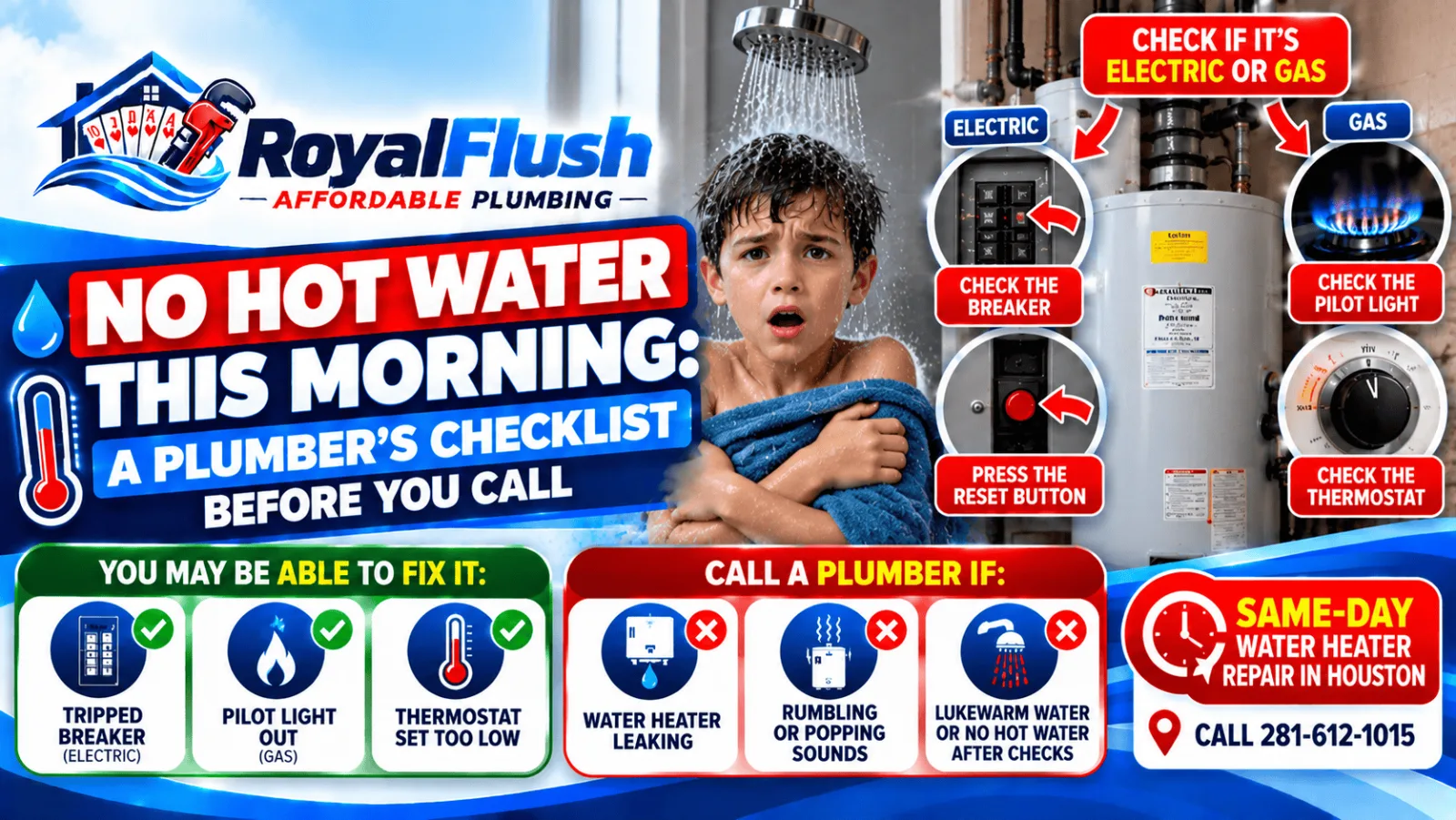
Cold shower, no warning. Before you call anyone, five minutes at the water heater will tell you whether this is a tripped breaker, a pilot that went out, a part that failed, or a tank that is done. Some of those you can fix yourself. The rest are a same-day repair, and knowing which is which saves the first ten minutes of the call.
If there is no hot water: for an electric heater, check the breaker and press the reset button under the upper access panel; for a gas heater, check whether the pilot is lit and relight it per the label if it is out. Then check the thermostat setting, make sure the cold inlet valve on top of the tank is open, and look at the pan under the tank for water. No power or no pilot you can often fix; a pilot that will not stay lit, a tripped reset that trips again, lukewarm water, or water in the pan all need a plumber. A tank leaking from the body itself is a replacement, not a repair.
- Electric: breaker first, then the red reset button behind the upper panel.
- Gas: look through the sight glass; no flame means the pilot is out.
- Lukewarm water, not cold, points to a failed element or thermostat, a dip tube, or a tank that is too small for the household.
- Water in the pan from the tank body means the tank has failed; from a fitting or the relief valve, it is a repair.
- Rumbling, popping or a heater over ten years old in Houston water: plan the replacement before it chooses the day.
First: is it the whole house or one tap?
Run hot water at two or three fixtures. If only one is cold, the problem is at that fixture: a failed cartridge in a single-handle faucet, a crossed connection, or a shutoff valve closed under that sink. The heater is fine. If every hot tap is cold, continue.
Electric water heaters
Gas water heaters
Both types: the three quick checks
Lukewarm, not cold
If there is some hot water but not enough, or it runs out quickly, the heater is working and something else is wrong: one of two elements has failed on an electric heater (the lower one, typically), the dip tube has broken, the thermostat is set low, sediment has taken up a third of the tank, or the household has outgrown the tank. Each has a different fix and a plumber identifies which in a few minutes.
What a plumber fixes the same day
Thermocouples and flame sensors, igniters, gas valves, heating elements, thermostats, dip tubes, relief valves, drain valves and leaking fittings are all stocked parts for the common brands, and the repair is usually done in one visit. A flush to remove sediment is part of the same visit if the tank is sound. The plumber will also check the venting on a gas unit and the pan drain, because no hot water is sometimes the first symptom of a problem that was going to show up another way.
When it is a replacement
A tank leaking from the body, a tank over 12 years old with a failed major part, or a tank that has rusted at the fittings so badly the fittings cannot be removed. In those cases the honest quote is for a new unit, with the question of tank or tankless answered from the house's gas line, venting and hot water demand rather than from a catalogue.
Avoiding the next cold morning
- Flush the tank once a year. In Houston's hard water this is the single biggest life extender.
- Check the anode rod every three to five years; a spent anode means the tank is rusting next.
- Keep the area around a gas heater clear so it gets combustion air.
- Know the age. If it is past ten, plan the replacement on a weekday of your choosing instead of a Sunday of its choosing.
Frequently asked questions
Why do I suddenly have no hot water?
The most common causes are a tripped breaker or high-limit reset on an electric heater, a pilot that has gone out on a gas heater, a failed element, thermostat or thermocouple, or a tank that has started leaking. The checks above sort them in five minutes.
How do I reset my water heater?
Electric: turn the breaker off, remove the upper access panel, press the red reset button on the thermostat until it clicks, replace the panel and restore power. Gas: relight the pilot following the label on the tank. If either trips or goes out again, a part has failed.
Is it safe to relight the pilot myself?
Yes, following the label's sequence and waiting five minutes with the gas off first. If you smell gas at any point, stop, leave the area and call the gas utility.
Why is my water lukewarm but not cold?
Usually a failed lower element on an electric heater, a broken dip tube, heavy sediment, a low thermostat setting, or a tank too small for the household. The heater is working but not fully.
How long should a water heater last in Houston?
Tank heaters typically last eight to twelve years here; hard water shortens the top end unless the tank is flushed yearly. Tankless units last longer with annual descaling.
Should I repair or replace?
Repair a sound tank with a failed part. Replace a tank that leaks from the body, is over 12 years old, or has a major failure. A plumber quotes both so you can compare.


