
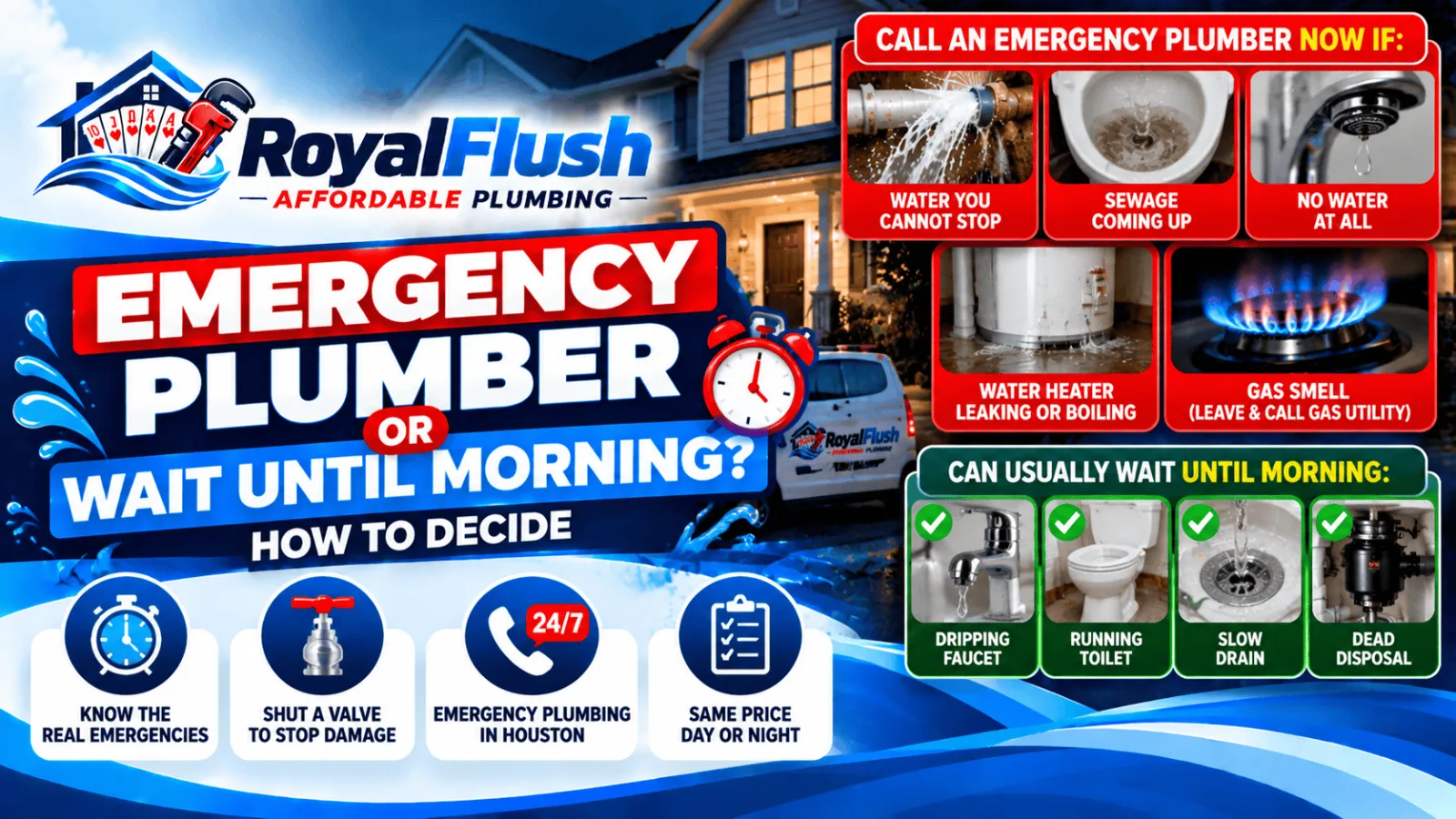
It is 10 p.m. and something is wrong with the plumbing. The question is not whether a plumber will come; emergency plumbers come. The question is whether this problem is one that gets worse by the hour or one that will be exactly the same, and cheaper, at 8 a.m. Here is how plumbers themselves sort the night calls.
Call an emergency plumber now if water is running and you cannot stop it, sewage is coming up a drain, the whole house has no water, a water heater is leaking from the tank or making a boiling sound, or you smell gas (leave the house and call the gas utility first). Wait until morning if it is a drip, a slow drain, a single running toilet, a dead garbage disposal, or no hot water with no leak. The test: is water or sewage going somewhere it should not, right now, and can you not stop it? If yes, call. If no, shut the valve, put a bucket under it, and sleep.
- Uncontrolled water or sewage is an emergency. Everything else can usually wait.
- Shutting a valve turns many emergencies into morning jobs.
- Gas smell is not a plumbing call first; it is a leave-the-house call.
- A night call costs more in stress than in dollars with upfront pricing, but it is still worth avoiding when the problem is stable.
- Tell the dispatcher what is happening and whether the water is off; it decides how fast you are seen.
Call now: the five real emergencies
1. Water you cannot stop
A burst pipe, a split supply line, a failed water heater tank, a fitting that has let go. If closing the fixture's own valve or the house main stops it, you have bought time (see below). If you cannot find the main, cannot turn it, or the water is coming from somewhere a valve does not reach, that is a now call. Water running for six hours does more damage than most repairs cost.
2. Sewage coming up
A main line stoppage pushes wastewater back into the lowest drains: a ground-floor tub, a shower, a floor drain. It is a health issue, it ruins flooring within hours, and every fixture used in the house adds to it. Stop using water and call. If the backup is only in one toilet and it stops when you stop flushing, it is a toilet clog and can wait.
3. No water at all
Every tap dry. Either the main has failed, the yard line has burst (look for water in the yard or at the meter), or the utility has an outage. Check with a neighbor first. If it is only your house, a burst yard line is wasting water into the ground and undermining the slab or driveway; that is a tonight call.
4. A water heater that is leaking from the tank, or boiling
A tank leaking from the body will fail completely, and 40 or 50 gallons on a floor is a flood. Close the cold inlet valve on top of the tank and the gas or power, then call. A heater making a rumbling, boiling, or kettle sound with scalding water at the taps has a failed thermostat or a stuck relief valve; turn it off and call. Do not wait on either.
5. Gas smell
Not a plumbing call first. Leave the house, do not switch anything on or off, and call the gas utility's emergency line from outside. Once the gas is shut off, the repair that follows is a licensed gas technician's job.
It can wait: the problems that only feel urgent
- A dripping faucet or a weeping valve. Put a towel under it. Morning.
- A running toilet. Close the valve behind the toilet and use another bathroom. Morning.
- One slow drain. Stop using that fixture. Morning.
- A clogged toilet that is not overflowing. Do not flush again. If there is a second bathroom, morning.
- A garbage disposal that hums or is dead. Do not run it; wash by hand. Morning.
- No hot water, no leak. Cold showers are unpleasant, not damaging. Check the breaker or pilot; otherwise morning.
- A dripping water heater relief valve pipe. A drip, not a stream. Morning, but do not ignore it.
- Low pressure in one fixture. Morning.
- A small leak under a sink that stops when the valve is closed. Close the valve, bucket, towel. Morning.
Every one of these has the same character: the water is either not moving or is under control. The repair is identical at 8 a.m. and the house is no worse for waiting.
The in-between: stable now, but
Some problems can wait a night but not a weekend. A sewer line that is slow but draining, a slab leak you have just confirmed with the meter, a water heater over ten years old with water in the pan from a fitting. Book the first available morning appointment rather than the next convenient week.
What shutting a valve buys you
Most "emergencies" become morning jobs the moment the water stops. The three valves to know: the small shutoff under each sink and behind each toilet, the cold inlet on top of the water heater, and the house main at the meter or where the line enters the house. Find them in daylight. A seized valve is the thing that turns a drip into a night call, so test them once a year and replace the ones that will not turn.
What to say when you call
Three things, and the dispatcher will do the rest:
- What is happening, in one sentence: "Water is coming through the dining room ceiling," "the ground-floor shower is filling with sewage," "the water heater is leaking from the bottom."
- Whether you have the water off, and which valve.
- Where you are and whether there is anything the technician needs to know to get in.
A caller with the main off and a clear description is seen in the right order, and the visit goes straight to the repair.
What an emergency visit looks like
Confirm the water is off and the lines are drained. Find the source, which is not always where the water appeared. Make the repair or, if a part has to be ordered, make the house safe and dry for the night with the failed section isolated. Pressurize, check, explain what caused it. Drying out a soaked structure is a restoration company's job; the plumber stops the water and fixes the pipe.
The honest word on cost
Night work is harder on everyone, and many companies charge for it. With upfront pricing the number is agreed before the work either way, so the real cost of a night call is the hour of worry. That is still a good reason to use the list above: if the water is stopped and nothing is getting worse, morning is cheaper in every way, and the repair is the same.
Frequently asked questions
What counts as a plumbing emergency?
Water or sewage going somewhere it should not, right now, that you cannot stop: a burst pipe, a sewer backup, a leaking water heater tank, no water to the house, or a gas smell. Drips, slow drains, single clogged toilets and no hot water are not emergencies.
Should I call a plumber at night for no hot water?
Not unless the heater is leaking or making a boiling sound. Check the breaker or pilot; if that does not fix it, a morning repair is the same repair.
What should I do before the emergency plumber arrives?
Shut the water off at the fixture valve or the house main, open a low faucet to drain the lines, cut power to any wet area at the breaker, move belongings out of the water, and take photos for insurance.
Is a clogged toilet an emergency?
Only if it is overflowing and will not stop, or if it is the only toilet. A clogged toilet that is not overflowing can wait: do not flush it again.
Does an emergency plumber cost more?
Some companies add after-hours fees. Royal Flush Affordable Plumbing quotes the price upfront before any work, with no hidden charges, day or night.
Who do I call for a gas smell?
The gas utility's emergency line, from outside the house. Do not operate switches or appliances. A licensed technician repairs the gas line after the utility has made it safe.


