Why Do I Keep Running Out of Hot Water from My Water Heater?

water heater

Why Do I Keep Running Out of Hot Water from My water heater? Proven Fixes

There is nothing more irritating than entering the shower and feeling how hot water turns cold in an instant. If you keep having problems with lack of hot water from your water heater, it means something goes wrong. In some cases, it could be a simple problem, but there are also situations when it requires professional intervention.
Fortunately, most hot water problems can be solved. You can learn about their causes and then solve the problem on your own. 

The most frequent reasons why your water heater doesn't work properly

1. Sediment Build-Up

One of the main factors why people have problems with hot water is sediment build-up. The reason is that there is always something in your water and it settles in the bottom of your tank.
As a consequence, the water heater works much harder in order to provide the required temperature of water. And in the end, the layer of sediment works like a thermal insulator. So, much less heat goes to the water.

Symptoms of Sediment Buildup

  • Shorter lasting time for the hot water supply.
  • Popping sounds coming from the tank.
  • Increased power bills.
  • Increased heating time.

Remedies

Draining the tank once or twice yearly will help get rid of any sediment present. Nonetheless, professional cleaning will be a safer choice in case of thick sedimentation.

2. Defective Heating Element

In case of electric water heaters, it may be due to defective heating elements. Electric water heaters usually contain two heating elements, and if one of them fails, the heater won’t heat sufficient hot water.
Consequently, you’ll notice your showers go cold very quickly.

Symptoms

  • Lukewarm water.
  • Fast depletion of hot water.
  • Long heating times.
A qualified plumber will conduct tests on the heating elements and replace the damaged one where necessary. Luckily, the repairs are quite easy to carry out.

3. Thermostat Issues

The thermostat regulates the temperature of your water heater. If the setting is low or if it stops functioning well, the water may never reach the right temperature.
Sometimes the thermostat will only need adjusting, but if the thermostat stops functioning well, then it may need replacing.

Look Out for These Signs

If your thermostat is not working properly, you may notice these signs:
  • First, the water temperature keeps changing.
  • Also, the water does not get hot enough.
  • In addition, you suddenly run out of hot water.
Therefore, it is a good idea to keep your water heater thermostat set to 120°F. This temperature provides enough hot water for everyday use while also helping reduce the risk of burns.

4. Inappropriate Tank Size

Sometimes there is nothing wrong with your water heater; instead, you just might have a too-small tank for your family.
For instance, when many family members are taking showers at once, and the dishwasher and washing machine are also in use, the tank could drain before having time to refill.

A Larger Tank Is Needed In Case:

  • You have expanded your family.
  • You got an additional bathroom.
  • Many devices operate simultaneously using hot water.
  • Hot water tends to run out in the morning.
For many homes, increasing the size of the tank or choosing a tankless water heater would be a better long-term choice.

DIY vs Professional Maintenance

A few maintenance activities can be done by the homeowner, but most issues include electric components, gas components, or high pressure in the plumbing system. Thus, repair work must be done carefully.

DIY Tasks

  • Set the temperature properly.
  • Search for any apparent leaks.
  • Clean the tank when advised by the manufacturer.
  • Inspect the surroundings of the appliance.

Contact a Professional If:

  • If your water heater is leaking, call a plumber as soon as possible.
  • Also, if you hear loud banging or popping noises, your water heater may need professional attention.
  • In addition, a faulty heating element should be replaced by an experienced technician.
  • Likewise, if the pilot light will not stay lit, it is best to have it inspected.
  • Finally, if you keep running out of hot water, a professional can find and fix the underlying problem.
The water heater is more than 10 years old.

Why Go With Royal Flush Affordable Plumbing?

If you’re having issues with your hot water flow, it’s important not to wait until the issue becomes severe. If you live in Houston, Royal Flush Affordable Plumbing is here to help you with speedy and effective hot water heater repair.
Our skilled technicians will be able to determine the problem right away and give you the best recommendations that will be affordable for you. Whether it’s an old tank water heater or a new tankless one, we can fix it and restore the hot water flow.

Why You Should Choose Us

  • Quick service
  • Transparent pricing
  • Professional and licensed plumbers
  • We provide expert hot water heater repairs for both tank and tankless water heaters, so you can enjoy reliable hot water again as quickly as possible.
  • Additionally, we deliver high-quality workmanship combined with exceptional customer service, ensuring every repair is completed with care and attention to detail.

So, don’t let a lack of hot water ruin your day. Contact us today to schedule your appointment, and let our experienced plumbers restore your hot water quickly and efficiently.

FAQs

Why does my water heater run out of hot water so fast?

The most common causes include sediment buildup, faulty heating elements, thermostat issues, or a water heater that is too small for your household.

Most experts recommend flushing your water heater at least once a year. Homes with hard water may benefit from more frequent flushing.

Yes. Sediment reduces heating efficiency, increases energy costs, and may shorten the life of your water heater if left untreated.

If your unit is under 10 years old, repairs are often worthwhile. However, older units with frequent problems may be better candidates for replacement.

Tank or Tankless Water Heater Houston: Which Option Is Best for Your Home?

Still stuck between a tank or tankless water heater?

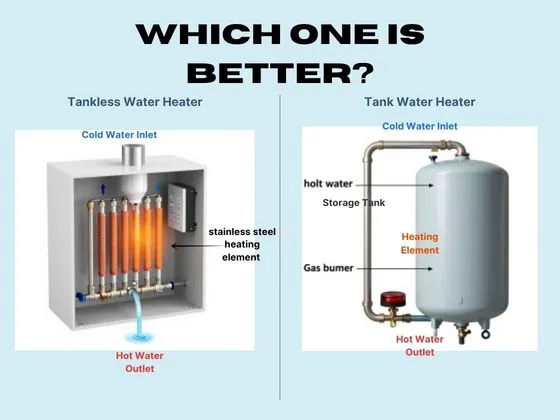
Choosing a tank or tankless water heater depends on your household’s hot water needs, budget, available space, and long-term energy goals. Both systems provide reliable hot water, but they differ in installation costs, energy efficiency, lifespan, and maintenance requirements. A tank water heater stores hot water for immediate use, while a tankless system heats water only when needed. Understanding these differences can help you avoid unnecessary expenses and ensure your home always has enough hot water.

This guide explains the tank or tankless water heater decision in simple terms, making it easier to choose the best option for your Houston home.

Tank or Tankless Water Heater- What's the difference

The distinction between a tank or tankless water heater is the heating and storage method of these devices.
The tank water heater can heat and store from 30 to 80 gallons of water all day long.
It means that at any time you will have access to hot water.
Unlike a tank water heater, a tankless water heater does not have a tank to heat and store water.
The water is heated as it passes through the device. It means that you will have hot water instantly but only within the limit of the flow rate and capacity of the device.
This distinctive feature influences all other aspects of the comparison

The price difference between a tank and tankless water heater.

The tankless units have higher initial costs. In 2026, the average cost of a whole-house gas tankless unit in Houston can be around $3,000 to $8,000. This depends on whether you need to get a bigger gas line or ventilation. Electric tankless units are usually cheaper and fall into the mentioned range.
The tank water heater will cost much less. A common 40- to 50-gallon tank water heater installation price can be around $1,200 to $2,500 for the Houston area, with old unit removal included.
Why is the price difference? Installation of the tankless units is not as easy as changing a tank. Gas units may require bigger gas lines, while electric units may require new panels. Hence, the labor prices are higher than those for tank replacement.
Yet, price is not everything. Long-term costs reverse the situation.

Which Water Heater Saves More Money Over Time?

Tankless units win here. According to the Department of Energy, tankless heaters run 24 to 34 percent more efficiently than tank models in homes using under 41 gallons a day.
Even high-use households still save 8 to 14 percent.
 
Why? Tank heaters constantly reheat stored water, even when nobody uses it. That’s called standby heat loss.
 
Tankless units, on the other hand, only fire up when you open the tap.
So while tankless costs more today, it typically pays that difference back through lower bills.
comparison between a tank or tankless water heater

Which Lasts Longer, a Tank or Tankless Water Heater?

Tankless water heaters last longer, running 15 to 20 years with proper maintenance. Tank units typically last 10 to 12 years nationally.
In Houston, that tank number drops further. Harris County water runs hard, and hardness accelerates sediment buildup. As a result, local tank units often need replacement closer to 7 to 10 years.
That gap matters for total cost of ownership. Tankless units also rarely rupture or leak, which lowers water damage risk. However, longevity depends on maintenance — which brings us to Houston’s biggest wildcard: water quality.

How Does Houston’s Hard Water Affect Tankless Water Heaters?

Houston’s water runs hard in many neighborhoods, with Harris County typically testing in the moderately-to-very-hard range. That matters more for tankless units than tank units.
 
Here’s why.
Minerals in hard water build up inside the tankless heat exchanger over time. This buildup, called scale, reduces efficiency and can shorten the unit’s lifespan.
The fix isn’t complicated, though.
Annual flushing by an affordable plumber in Houston removes buildup before it causes damage. A whole-home softener reduces the problem even further. So if you go tankless in Houston, budget for that yearly step.

What Sized Water Heater is usually recommended

Household size is one of the biggest factors when deciding between a tank or tankless water heater. Choosing the right size is just as important as selecting the right system. A couple or a family of two or three will usually do well with a 40-gallon tank water heater or a mid-sized tankless unit.

For families of four or five, a 50-gallon tank is often the better fit. Likewise, a properly sized tankless water heater with a higher flow rate can provide enough hot water for daily needs.

However, proper sizing is essential. Many complaints about tankless systems happen because the unit is too small. If your tank or tankless water heater is undersized, you may run into problems when using multiple fixtures at the same time, such as the dishwasher, washing machine, and showers.

Still Deciding Between a Tank or Tankless Water Heater? Let Royal Flush Affordable Plumbing Make It Easy For You.

Choosing the right water heater isn’t just about upfront cost — it’s about matching the system to your home, your water usage, and Houston’s notoriously hard water. That’s where a quick call to Royal Flush Affordable Plumbing pays off.

Why Homeowners Trust Royal Flush for Water Heater Installation

Whether you’re leaning toward the lower upfront cost of a tank system or the long-term efficiency of going tankless, our licensed Houston plumbers help you cut through the guesswork. We evaluate your household size, daily hot water demand, and space constraints — then recommend a properly sized unit so you’re never caught short during back-to-back showers and laundry loads.

Built for Houston’s Hard Water

Harris County’s hard water is tough on tankless heat exchangers, causing mineral scale buildup that quietly reduces efficiency and shortens lifespan. Our team offers annual flushing and maintenance service to keep your tankless unit running at peak performance for the full 15–20 year lifespan it’s built for — protecting your investment instead of letting it fail early.

What You Get With Royal Flush Affordable Plumbing:

  • Free in-home consultation to determine tank vs. tankless fit
  • Transparent, upfront pricing on installation — no surprise labor fees
  • Licensed handling of gas line upgrades or electrical panel work for tankless installs
  • Annual maintenance plans to combat Houston’s hard water damage
  • Same-day and emergency service, 24/7 Sunday–Friday

Don’t Let Guesswork Cost You Money

A water heater is a 10-to-20-year decision. Get it right the first time with a team that knows Houston’s water, homes, and hot water demands inside and out.

📞 Call 281-612-1015 or book an appointment online for your free water heater consultation.

FAQ

Do tankless water heaters work during a Houston power outage?

Gas units usually need electricity for ignition, so most won’t work without power or a backup source. Electric tankless units won’t work at all during an outage.
Not typically. It can fall behind, though, if you run multiple fixtures at once and exceed the unit’s flow rate. Correct sizing prevents this.
Once a year, according to most manufacturers, in hard water regions like Houston. A water softener can stretch that interval longer. Proper maintenance by a reputable plumbing company providing water heater service should be fine.
Gas suits larger households with higher flow needs, but costs more to install if a gas line upgrade is required. Electric costs less and suits smaller households.