
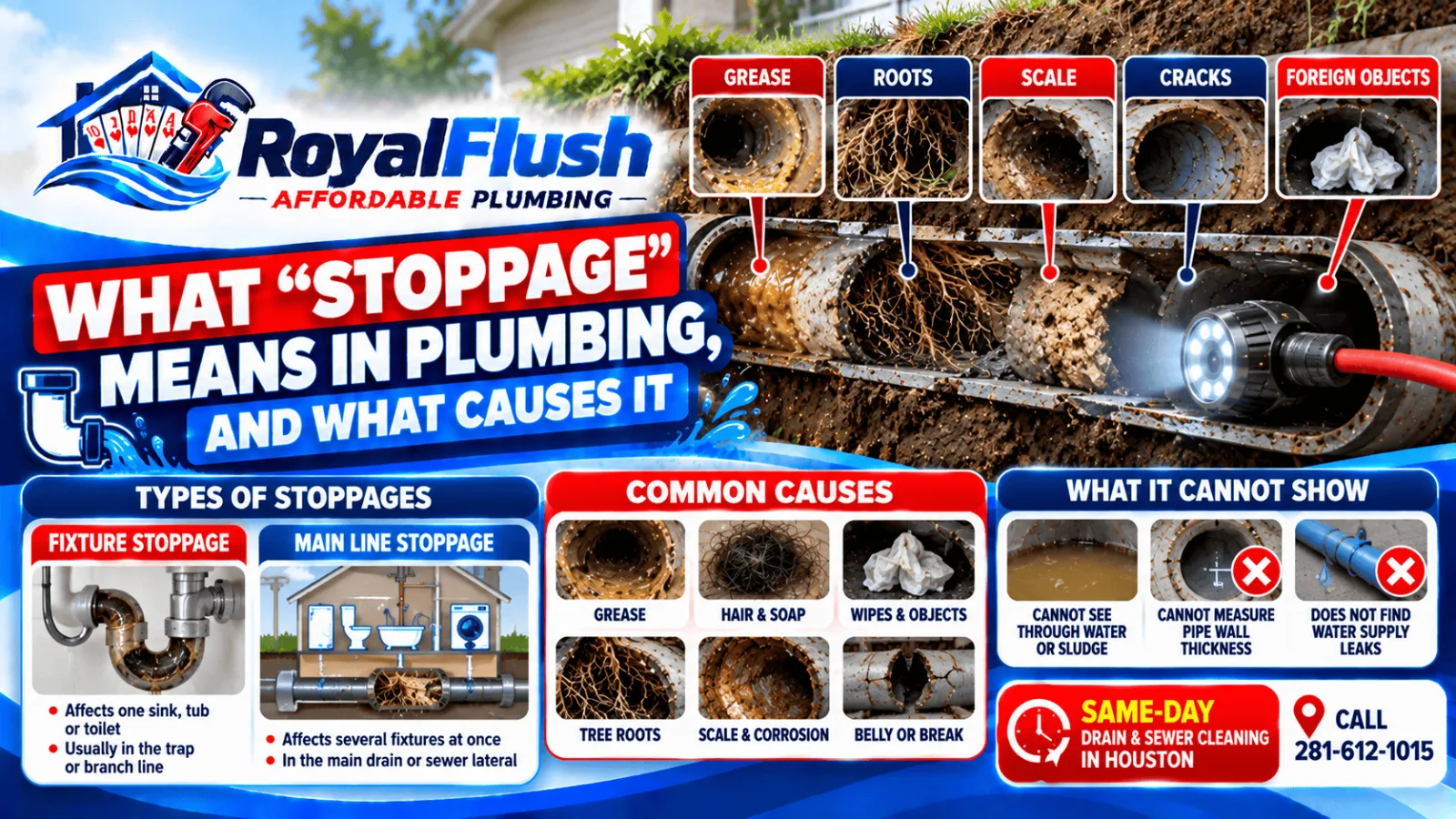
Plumbers say "stoppage" where homeowners say "clog," and the word carries a little more meaning. A clog is something stuck in a pipe. A stoppage is the condition: water has stopped moving through a drain or sewer line, for whatever reason. The reason matters, because a stoppage caused by a wad of wipes and one caused by a collapsed clay pipe look identical from the bathroom and are nothing alike underneath.
A plumbing stoppage is a blockage that stops wastewater from flowing through a drain or sewer line. A fixture stoppage affects one sink, tub or toilet and sits in its trap or branch line. A main line stoppage affects several fixtures at once and sits in the house's main drain or the sewer lateral to the street. The six common causes are grease, hair and soap, wipes and foreign objects, tree roots, scale in old cast iron, and a sagging or broken pipe. Cabling clears the first three; jetting handles grease, roots and scale; a broken pipe needs repair.
- One fixture slow or stopped: fixture stoppage. Several at once, or the lowest drain backing up: main line stoppage.
- The cause decides the tool. A cable breaks a plug; a jetter cleans a lining; neither fixes a broken pipe.
- Repeat stoppages in the same line mean the cause was never removed, only pushed through.
- A camera inspection after clearing shows which of the six causes you have.
- Stop running water the moment a main line stoppage shows. Every gallon comes back up somewhere.
Fixture stoppage vs main line stoppage
Every fixture has its own trap and a short branch line that joins the house's main drain. The main drain collects everything and runs out to the sewer lateral, which connects to the city main under the street.
A fixture stoppage is in the trap or the branch. The bathroom sink drains slowly; everything else is fine. It is close to the fixture, reachable with small tools, and rarely urgent.
A main line stoppage is downstream of where the branches join. Because every fixture drains into the same pipe, the symptoms show in more than one place: the toilet gurgles when the washing machine drains, the shower fills when the toilet flushes, and the lowest drain in the house, usually a ground-floor tub or shower, is where the backup first appears. A main line stoppage is urgent, because water from any fixture in the house now has nowhere to go but back.
Telling the two apart is the first thing a plumber does on the phone, and it is the first thing you should do too.
The six causes
1. Grease and food (kitchen lines)
Cooking fat goes down hot, cools in the horizontal branch line and sets on the pipe wall. Layer by layer it narrows the pipe until a dishwasher cycle or a sink full of water cannot get through. Cabling bores a hole through the lining; the hole closes again within months. Hydro jetting strips the wall and resets the line.
2. Hair and soap scum (bathroom lines)
Hair binds with soap into a mat at the drain or in the trap. This is the most DIY-able stoppage: a strainer prevents it and a hand snake clears it. In older homes it can travel further into the branch and need a machine.
3. Wipes, hygiene products and foreign objects (toilets and main lines)
"Flushable" wipes do not break down. They catch on any rough spot or joint and build a dam that collects everything behind it. Toys, toothbrushes and phones block the toilet's own trap. A closet auger clears the toilet; wipes in the main line take a cable, and sometimes a camera to find the dam.
4. Tree roots (sewer laterals)
Roots find the moisture at pipe joints and grow into the line, a few hairs at first, then a mat that catches paper and solids. Clay pipe with many joints and old cast iron with open seams are the usual hosts, and Houston's live oaks and willows are relentless. A root-cutting cable head clears them for a season; jetting clears them better; the camera shows whether the pipe is sound enough to keep cleaning or whether the joint has broken and needs repair or relining.
5. Scale and corrosion (cast iron)
Cast iron drain lines rust from the inside. The surface turns rough and the bottom of the pipe channels and flakes, so the pipe both narrows and catches everything. Jetting cleans what can be cleaned; a camera shows how much pipe wall is left. At some point cleaning stops being a fix and the line is replaced or relined.
6. A belly or a break (the pipe itself)
Houston's clay soil moves. A section of pipe sinks and forms a belly that holds standing water and solids; a joint offsets; a pipe cracks or collapses. Nothing stays clear in a bellied or broken section for long. The stoppage returns on a schedule until the section is repaired, and no amount of cabling changes that.
How each one is cleared
| Cause | Where it usually is | Clears it | Lasting fix |
|---|---|---|---|
| Grease | Kitchen branch | Cable (short term) | Hydro jetting, habits |
| Hair and soap | Bathroom trap and branch | Hand snake, cable | Strainers |
| Wipes and objects | Toilet trap, main line | Auger, cable | Nothing but paper in the toilet |
| Roots | Sewer lateral | Root cutter, jetting | Jetting on a schedule, repair or relining of the joint |
| Scale and corrosion | Cast iron under the slab | Jetting | Replacement or relining when the wall is gone |
| Belly or break | Anywhere the soil moved | Temporary at best | Spot repair, replacement or trenchless relining |
Why the camera matters after the clearing
Clearing a stoppage restores flow. It does not tell you why the stoppage happened, and causes four, five and six all come back. A camera run through the line immediately after clearing, while the pipe wall is visible, shows roots, scale, a belly or a break with a distance marker, and that decides whether the line needs a cleaning schedule, a repair, or nothing more. On a first-time stoppage in a newer PVC line it may be unnecessary; on a repeat stoppage or an older home it is the difference between paying for the same clearing every few months and fixing the cause once.
What to do during a main line stoppage
- Stop using water. Every flush, every load of laundry, every shower adds to what is backing up.
- Find the cleanout if you know where it is, and clear the way to it. Do not open it.
- Move things off the floor around the lowest drain.
- Call, and say which fixtures are affected and whether you have a cleanout. That tells the plumber what equipment to bring and gets you seen in the right order.
Frequently asked questions
What is the difference between a stoppage and a clog?
A clog is the object or buildup; a stoppage is the condition of a drain or sewer line that no longer flows. Plumbers use "stoppage" because the cause may be a clog, roots, scale or a broken pipe, and each is handled differently.
What is a main line stoppage?
A blockage in the house's main drain or the sewer lateral to the street, downstream of where the individual fixtures join. It affects several fixtures at once and shows first at the lowest drain in the house.
Why does my stoppage keep coming back?
Because the cause was pushed through, not removed. Grease lining, roots, scale, a belly or a break all return on a schedule after cabling. Jetting addresses the first three; a repair addresses the last two. A camera inspection tells you which you have.
Can I clear a main line stoppage myself?
Rarely. The blockage is beyond the reach of hand tools and the line is 3 to 4 inches across. A rented machine without training can damage old pipe or get stuck. Main line stoppages are a plumber's job from the cleanout.
Is a stoppage an emergency?
A fixture stoppage usually is not. A main line stoppage is, because wastewater from the whole house will back up into the lowest fixtures. Stop running water and call.
Does a stoppage mean my sewer line is broken?
Not necessarily. Most stoppages are grease, wipes or roots in a sound pipe. A camera inspection after clearing is the only way to know whether the pipe itself is damaged.


