
A sewer camera inspection is the only way to see inside a drain or sewer line without digging it up. It answers the question every recurring backup raises: is the pipe fine and just dirty, or is the pipe the problem? Here is exactly what the camera finds, what it misses, how the visit works, and the situations where it is worth the fee.
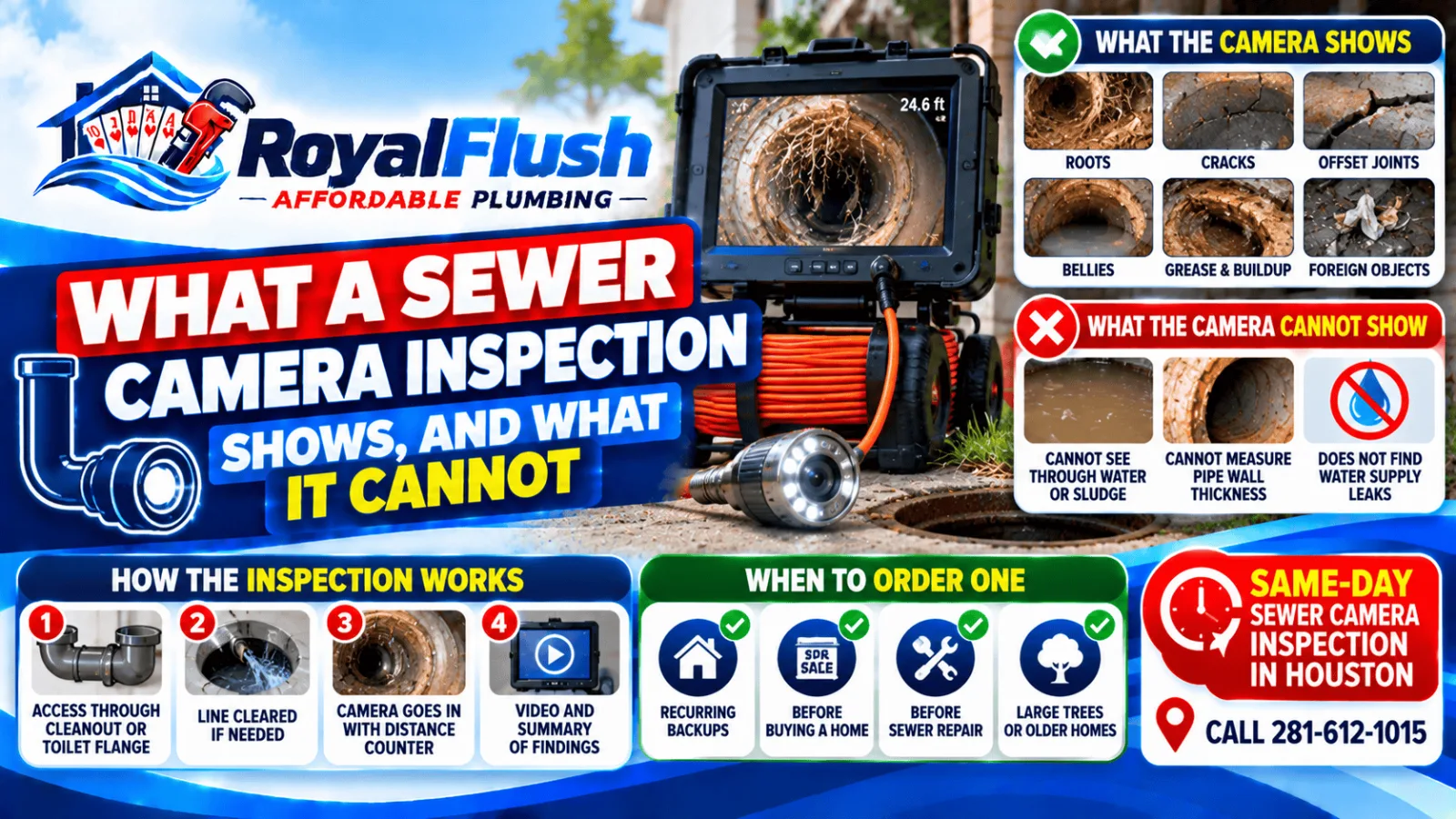
A sewer camera inspection pushes a waterproof camera on a cable through the drain line from a cleanout or a pulled toilet, recording video of the pipe interior with a distance counter. It shows roots, cracks, offset joints, bellies holding water, grease and scale buildup, collapsed sections and foreign objects, and it locates each one so a repair can be targeted. It cannot see through standing water or heavy debris, cannot measure pipe wall thickness, and cannot confirm a leak on the water supply side. It takes about an hour and ends with a video and a plain-language summary.
- The camera shows the condition of the pipe wall and locates problems to the foot.
- It is most useful after a line has been cleared, when the wall is visible.
- It does not see through water or sludge, so a fully blocked line is cleared first.
- Order one for repeat backups, before buying an older home, and before any sewer repair quote.
- The output is a video you keep; a quote without one is a guess.
How the equipment works
The camera head is about the size of a golf ball, sealed, lit by LEDs, and mounted on a stiff push cable wound on a reel. The operator feeds it into the line through a cleanout, a roof vent, or the toilet flange with the toilet removed. A monitor on the reel shows the live picture and the footage counter shows how far in the head is. Most heads carry a transmitter, so a locator above ground can find the exact spot and depth of anything the camera sees. The result is a recording, usually a file sent to the homeowner, with the distance and a description of each finding.
What the camera shows
Roots. Fine hairs at a joint, a curtain across the pipe, or a mat filling it. The camera shows how far in they are and how many joints are affected, which decides whether jetting on a schedule is enough or whether the joint has broken.
Cracks and breaks. Longitudinal cracks in clay or PVC, broken pipe sections, holes in cast iron. Visible as lines, gaps or soil showing through the wall.
Offset joints. Where the soil has moved and one section no longer lines up with the next, leaving a lip that catches everything. Common in Houston clay.
Bellies. A sagging section where water stands even after flushing. The camera lens goes underwater and the counter marks the length of the dip. Bellies collect solids and cause recurring stoppages.
Grease, scale and buildup. The pipe's diameter visibly reduced by a lining on the wall. On cast iron, the rough, channelled surface of corrosion.
Collapse. The camera cannot pass. The pipe has failed and the section must be replaced.
Foreign objects and construction debris. Wipes dams, a child's toy, a chunk of mortar from a remodel. Located to the foot.
Transitions. Where cast iron meets PVC from a past repair, where the house line meets the city tap, the depth and direction of the run under the slab. Useful for planning any future work.
What the camera cannot show
Anything under standing water or sludge. If the line is fully blocked, the camera sees murk. The line is cleared first, then inspected.
Wall thickness. Cast iron can look intact on the inside and be paper-thin. The camera shows surface condition, not remaining metal.
Small leaks in the pipe wall. A hairline crack that leaks outward may not be visible, especially under water. A sewer line leak test is a separate procedure.
Water supply leaks. The camera is for drains and sewers. A slab leak on the pressurized water lines is found by pressure testing and listening equipment, not a camera.
What the future holds. The camera shows today. A sound pipe with roots at one joint will have roots at more joints in five years.
How the visit goes
- The plumber asks what the symptoms are and where the cleanout is. No cleanout means the camera goes through a roof vent or a pulled toilet, which adds time.
- If the line is backed up, it is cleared first so the wall can be seen.
- The camera goes in and is pushed to the city connection, stopping to record and locate each finding. The operator narrates.
- Anything significant is marked above ground with paint or a flag and its depth noted.
- The homeowner gets the video and a summary: what was found, at what distance, and what it means. If a repair is recommended, the quote references the footage.
About an hour for a typical house. Longer with no cleanout or a very long lateral.
When it is worth ordering
- A stoppage that has returned. Once is bad luck. Twice in a year is a cause that cabling did not remove, and the camera names it.
- Before buying a home built before 1980, or any home with large trees over the lateral. The most valuable plumbing test a Houston buyer can order.
- Before approving any sewer repair. A quote to dig up a yard should come with footage showing why.
- After a repair or relining, to confirm the work.
- Sewer smell, soft or green patches in the yard, or a toilet that gurgles when nothing explains it.
- Before a remodel that adds a bathroom or moves fixtures, to confirm the line can take it.
When it is not worth it
A first-time clog in a newer PVC line, cleared with a cable, in a house with no history: the camera will show a clean pipe and tell you nothing you did not know. Save it for the second time. Likewise, a fixture stoppage in a bathroom sink is a trap problem, not a sewer problem; the camera is a main line tool.
Reading your own video
Clear, round pipe with the camera gliding along the bottom is a healthy line. Water the camera has to wade through that does not drain is a belly. A lip the camera bumps over is an offset. Fibrous strands reaching in from the wall are roots. A wall that looks like the inside of a rusty pipe is cast iron corrosion. If the operator says "collapse," the camera has stopped against soil or a crushed section. Ask the plumber to pause and explain each one on the recording; a good operator will.
Frequently asked questions
How long does a sewer camera inspection take?
About an hour for a typical house with a cleanout. Longer if the line has to be accessed through a roof vent or by pulling a toilet, or if the line must be cleared first.
Does a sewer camera inspection damage the pipe?
No. The camera head is pushed gently along the pipe and is designed for this. In a collapsed or badly broken line the operator stops rather than forcing it.
Can the camera find a leak?
It shows cracks, breaks and open joints in the drain line, which are where leaks happen. It cannot see a leak that is only visible from outside the pipe, and it is not used for water supply leaks, which are found by pressure testing.
Do I need a cleanout for a camera inspection?
It is easiest with one. Without a cleanout the camera goes in through a roof vent or the toilet flange, which takes longer. Many homeowners have a cleanout installed during the same visit.
Should the line be cleaned before the inspection?
If it is backed up, yes; the camera cannot see through water and sludge. If the line is flowing, the inspection can be done first and cleaning decided from what it shows.
Will I get a copy of the video?
Yes, with a summary of each finding and its distance from the access point. Keep it. It is the document any repair quote should refer to.


