
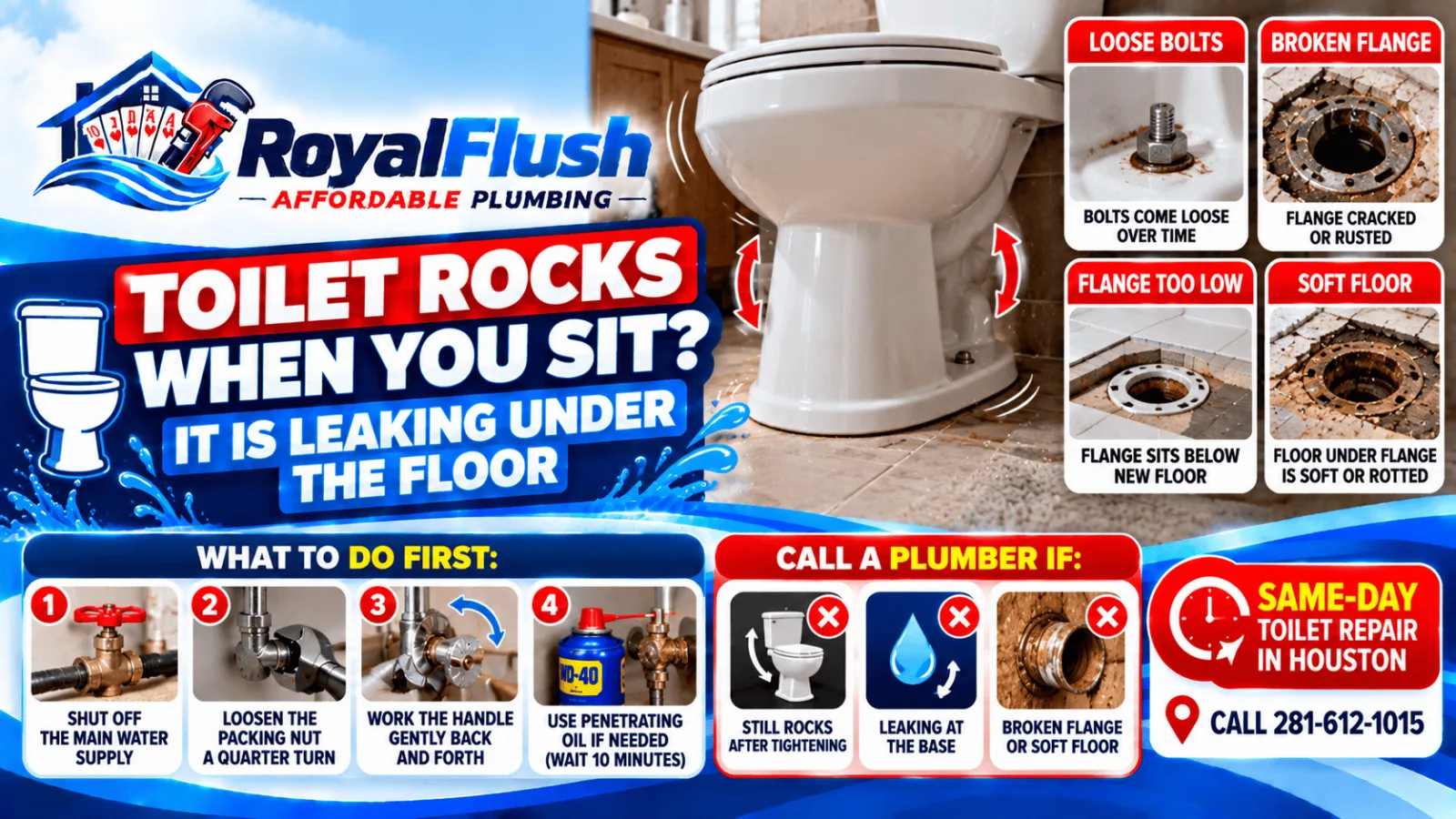
A toilet that moves when you sit on it feels like a loose bolt. Sometimes it is. More often the bolts are tight and the toilet rocks because the thing it is bolted to, the flange under the floor, has broken, or because the floor under the flange has gone soft. Either way, the wax seal that keeps sewage in the pipe is no longer sealed, and every flush is sending a little water under the floor where you cannot see it.
A rocking toilet has lost its seal. The usual causes are closet bolts that loosened, a flange that cracked or rusted, a flange that sits too low after a new floor, or a subfloor that has softened from an earlier leak. Snugging the bolts fixes only the first cause and can crack the porcelain if overdone. The real fix is to lift the toilet, inspect and repair the flange, and reset the toilet on a new wax ring, which a plumber does in about an hour. Left alone, the leak rots the subfloor, stains the ceiling below, and in a slab home seeps into the concrete.
- Rocking means the wax seal is broken, even if nothing looks wet.
- Tightening the bolts is a temporary fix at best; over-tightening cracks the base.
- The flange, not the toilet, is usually what failed.
- A toilet that has rocked for months has probably damaged the floor under it.
- Lift, inspect, repair the flange, new wax ring, reset: one visit.
Why a toilet is supposed to be rigid
A toilet is held to the floor by two closet bolts that pass through the base and hook into slots in the closet flange, the ring attached to the top of the drain pipe. Between the toilet's outlet and the flange sits a wax ring, compressed when the toilet is bolted down. The wax does not hold the toilet; the bolts do. The wax only seals. So the toilet must not move at all, because any movement works the wax loose, and wax does not re-seal once it has been disturbed.
A toilet that rocks has already broken that seal. Water, and whatever is in it, escapes around the outlet with each flush, runs across the top of the flange and down the outside of the drain pipe, and soaks into whatever is under the floor.
The four reasons toilets rock
1. Loose closet bolts
The simplest case. The nuts backed off over the years, or the toilet was never tightened properly. Pry off the caps and snug the nuts a little at a time, alternating sides, until the toilet stops moving. Stop before you feel real resistance; porcelain cracks silently. If it stops rocking and stays stopped, you may have caught it early, but the wax ring has still been disturbed and may be leaking. Watch for signs for a few weeks.
2. A broken flange
Cast iron flanges in homes from the 1950s to 1970s rust until the bolt slots crumble. PVC flanges crack at the slots when the toilet is over-tightened or rocked for years. Once the slot is gone, the bolt has nothing to hold, the nut tightens against air, and the toilet rocks no matter what you do. This is the most common cause in older Houston neighborhoods and it is not visible without lifting the toilet.
3. A flange below the floor
A new tile floor laid over the old one raises the floor level, and the flange stays where it was, now half an inch or more below the finished surface. The toilet sits on the tile, the wax ring cannot reach the flange, and the base has no solid contact. Shims stop the rocking but do not fix the seal.
4. A soft or uneven floor
In a pier-and-beam home, or a slab home with a thick mortar bed under the tile, a leak that has run for a while softens the subfloor or crumbles the mortar around the flange. The toilet then sits on a surface that gives. Tightening the bolts pulls the toilet down into the soft spot and makes it worse.
Signs the leak has been going on for a while
- A faint sewer smell in the bathroom that cleaning does not remove.
- Discolored or lifting flooring around the base; grout that darkens; a vinyl floor that bubbles.
- A stain on the ceiling of the room below (for an upstairs bathroom).
- The floor near the toilet feels softer than the rest of the room.
- Water appears at the base after a flush but not between flushes.
Any of these with a rocking toilet means the floor under it is already involved.
What to do today
- Stop using that toilet if it rocks noticeably, or at least stop flushing it heavily. Every flush adds water under the floor.
- If the bolts are loose, snug them gently and see whether the rocking stops. Do not shim and forget.
- Look for the signs above. If any are present, this is a lift-and-inspect job, not a bolt job.
- Have it looked at within days, not months. The cost difference between a flange repair and a subfloor repair is the time the leak ran.
How a plumber fixes it
The water is shut off, the tank emptied, and the toilet lifted and set aside. The old wax is scraped off and the flange is inspected. The repair depends on what is found:
- Sound flange, loose bolts: new closet bolts, new wax ring, toilet reset and tightened evenly. The quick version.
- Broken flange slots: a steel repair ring screwed down over the existing flange restores the bolt slots without replacing the flange. Common and reliable on PVC and on cast iron that is otherwise solid.
- Rusted-through cast iron flange: the old flange is cut away and a new flange fitted to the pipe. More work, still one visit in most cases.
- Flange below the floor: a flange extender or spacer kit brings it up to the finished floor, with a wax ring sized for the new height.
- Soft subfloor: the floor around the flange is opened and repaired before the toilet goes back. On a slab home with a damaged mortar bed, the bed is rebuilt. If the drain pipe under the slab is suspected, a camera inspection goes in before the toilet goes back.
Then the toilet is set on a new ring, bolted evenly, the supply reconnected with a new line, and flushed several times while the base is checked dry. A toilet that was rocking should not move at all when the plumber leaves.
Why it is worth fixing properly
The repair is small. The damage from not doing it is not: a rotted subfloor in a frame home, a stained and sagging ceiling below an upstairs bath, tile that has to come up, and in a slab home, sewage seeping into the concrete and the smell that comes with it. A rocking toilet is the cheapest plumbing warning a house gives.
Frequently asked questions
Is a rocking toilet dangerous?
Not dangerous to sit on, but it is leaking wastewater under the floor with every flush, which damages the floor and can cause a sewer smell and mold. It should be fixed within days.
Can I just tighten the bolts?
If they are loose, snug them gently and see whether the rocking stops. If it does not, or if it returns, the flange or the floor is the problem and the toilet has to be lifted. Over-tightening cracks the porcelain base.
Can I use shims to stop a toilet rocking?
Shims level a toilet on an uneven floor during a proper installation. Shimming a toilet that has started rocking hides the symptom and leaves the broken seal leaking.
What is a toilet flange?
The ring, usually PVC or cast iron, attached to the top of the drain pipe at floor level. The toilet bolts to it and the wax ring seals against it. A cracked or rusted flange is the most common reason a toilet rocks.
How much does it cost to fix a rocking toilet?
It depends on what is under it: a new ring and bolts, a flange repair ring, a new flange, or a floor repair. A plumber lifts the toilet, tells you which, and gives the price before doing the work.
Why does the toilet rock only when I sit?
Body weight shifts the bowl on a broken flange slot or a soft floor. The seal is broken whether or not it moves between uses.


