
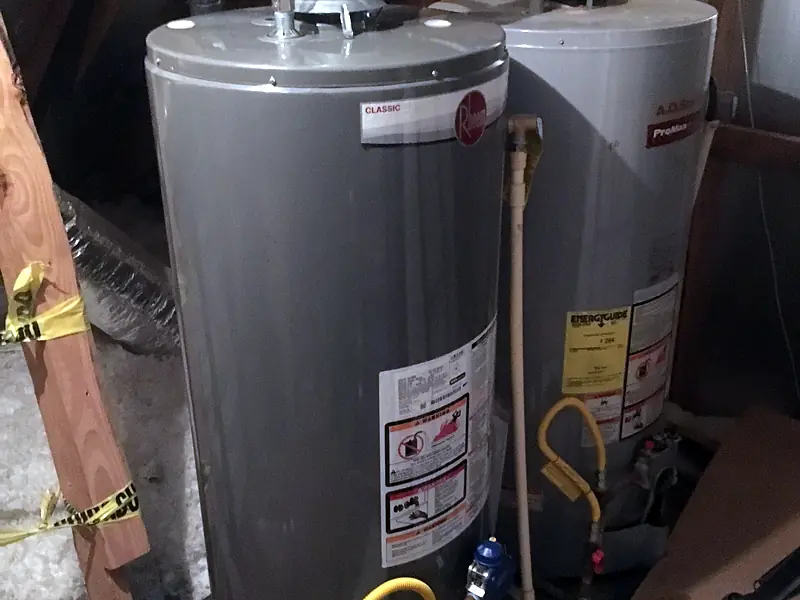
A water heater that stops working rarely does it at a good time, and the first question is always the same: can it be fixed, or is it done? Plumbers get asked it constantly, and the fair answer is that it depends on three things you can check yourself: how old the heater is, what exactly has failed, and what the repair would cost compared with a new unit. This guide shows how to weigh them.
Repair a water heater when it is fairly young, the fault is a replaceable part such as a thermostat, heating element, igniter, thermocouple, relief valve or gas control, and the repair costs well under half the price of a replacement. Replace it when the tank itself is leaking, when it is old and showing rust or repeated failures, or when a repair would cost close to a new heater. A leaking tank cannot be repaired. A sensible plumber gives you both prices and tells you which one they would choose.
- A leaking tank means replacement. A failed part means a repair is worth considering.
- Age matters more than anything else. A tank heater past its expected life is a poor place to spend repair money.
- A common rule of thumb: if the repair costs about half the price of a new heater or more, replace.
- Replacement is also the moment to fix what was never right: a missing drain pan, a wrong relief pipe, no expansion tank, an undersized gas line.
- Ask for both prices, and ask what you are paying for in each.
Start with what has actually failed
Water heater problems fall into two groups, and they point in different directions.
Problems that are usually repairable
No hot water from an electric heater. A failed heating element, a tripped high-limit reset or a bad thermostat. These are replaceable parts.No hot water from a gas heater. A pilot that will not stay lit, a thermocouple or flame sensor that has failed, a bad igniter or a faulty gas control valve.Lukewarm water. A single element out of two, a thermostat set too low or a dip tube that has broken down.A dripping relief valve. The valve itself is worn or the pressure in the system is too high. Both are fixable.A leak at a connection, fitting or drain valve rather than from the tank.Noise from scale, which a flush often reduces.A tankless unit with an error code, commonly scale in the heat exchanger or a blocked vent, cleared by descaling and service.
Problems that usually mean replacement
Water leaking from the tank itself, at the seams, the bottom or through the jacket. The steel tank has corroded through. It cannot be patched.Rust-colored hot water that comes from the heater, a sign the tank lining is failing.A bulging or distorted tank. Repeated failures, where a second or third part has failed in a short time.A very old heater with a major fault. Spending real money on a heater that is already at the end of its life is a poor bet.
Age: the most important number
The age is on the data plate or in the serial number, and the manufacturer's website decodes it. As a general guide, many tank heaters last around ten years, give or take, depending on the water and on how they have been looked after. Hard water, no flushing and a spent anode rod shorten that. Tankless units often last considerably longer when they are descaled regularly.
A rough way to think about it:
Under about five years: repair almost anything repairable. The heater has most of its life ahead of it.About five to eight years: weigh the cost of the repair against the price of a new unit. A cheap part is still worth it.Around ten years or more: a major repair is hard to justify. Even if this one is fixed, the next one is likely close.
These are not rules. A well-maintained heater on soft water can run well past the guide, and a neglected one can fail early.
The cost comparison
You do not need exact figures to make the call. You need two numbers from the plumber: the cost of the repair and the cost of a replacement installed. Then:
Repair costs far less than half a replacement, and the heater is not old: repair.Repair costs about half of a replacement or more: replace, unless the heater is young.Repair is a stopgap: a plumber can tell you whether the fix will hold or whether something else is about to fail. If they say it might, factor that in.
Do not count only the heater. A replacement installed correctly often includes the parts that make it safe and long-lasting: a drain pan and drain line, a new relief valve and discharge pipe, an expansion tank where one is needed, new connectors and shutoffs, correct venting and, for a gas unit, a gas line that carries the load. If the old installation lacked these, a replacement is the chance to correct them.
Efficiency and running cost
A new heater is generally more efficient than one that is ten or more years old, and a heater that is scaled up burns more fuel to deliver the same water. That matters most in a household that uses a lot of hot water. It is a point in favor of replacement, but a small one next to the cost of the unit, and it does not outweigh a cheap repair on a young heater.
If you are replacing, you can also change the type. Tank to tankless is possible when the venting, the gas line and the location allow it, and the details are different for each house. See our guide on condensing and non-condensing tankless heaters and our page on tankless water heater installation.
Special situations in Houston
Attic heaters. A leak in an attic ruins a ceiling. A drain pan piped to a visible discharge point is not optional, and it should be part of any replacement.Hard water. Scale shortens the life of tank and tankless heaters alike. A softener helps. See our page on water softener installation.A flood or a long power outage. A heater that has been under water should be inspected before it is used again.A heater in a garage or closet. Check the venting and clearances, and keep flammable products away.
Questions to ask the plumber
- What exactly has failed, and can you show me?
- How old is the heater, and what does that mean for this repair?
- What does the repair cost, and what does a replacement cost, installed?
- Will the repair last, or is something else likely to fail soon?
- If we replace it, what comes with the installation: pan, relief valve and pipe, expansion tank, connectors, venting, permit?
- Can the gas line, the venting and the location support a different type of heater?
- Will I get a written work order and invoice?
A plumber who gives you only one option is not helping you decide. Royal Flush Affordable Plumbing gives you both prices when both make sense, and says which one we would choose. Our work is done under Texas Responsible Master Plumber License RMPL #42403.
A quick decision table
| Situation | Usual answer |
|---|---|
| Leaking from the tank | Replace |
| Failed element, thermostat, igniter or sensor on a heater under about eight years | Repair |
| Failed part on a heater near ten years or older | Repair only if it is cheap, otherwise replace |
| Rusty hot water, bulging tank | Replace |
| Several failures in a short period | Replace |
| Dripping relief valve, heater in good shape | Repair, and check the system pressure |
| Tankless with an error code | Service and descale, then reassess |
| Heater is fine but noisy | Flush, and consider a softener |
Frequently asked questions
How do I know how old my water heater is?
Check the data plate on the tank for the date or serial number. The first letters and digits of the serial number usually encode the month and year, and the manufacturer's website can decode it. A plumber can read it on the spot.
Is it worth repairing a ten-year-old water heater?
Only if the repair is inexpensive. A heater around ten years old is near the end of the typical life of a tank unit, and a major repair is poor value when the next failure may be close. A plumber can tell you how it looks.
Can a leaking water heater tank be repaired?
No. A tank that leaks from the seams, the bottom or through the jacket has corroded through, and it has to be replaced. A leak at a fitting or valve is different and is often a simple repair, which is why the source matters.
How long does a water heater replacement take?
A standard replacement in an accessible location is usually completed in one visit. Changing the type, moving the heater, upgrading the gas line or venting, or working in a tight attic adds time. We give you the schedule when we price the job.
Should I switch to tankless when I replace?
It can be a good choice if the venting, the gas supply and the location allow it, and if you value the space and the running cost. It costs more to install than a tank. Ask for both quotes, and see our guide on condensing and non-condensing units.
Does a new water heater need a permit?
Replacing a water heater commonly needs a plumbing permit in many jurisdictions, and the rules depend on your city or county. Ask the plumber what applies at your address before the work is scheduled.


