
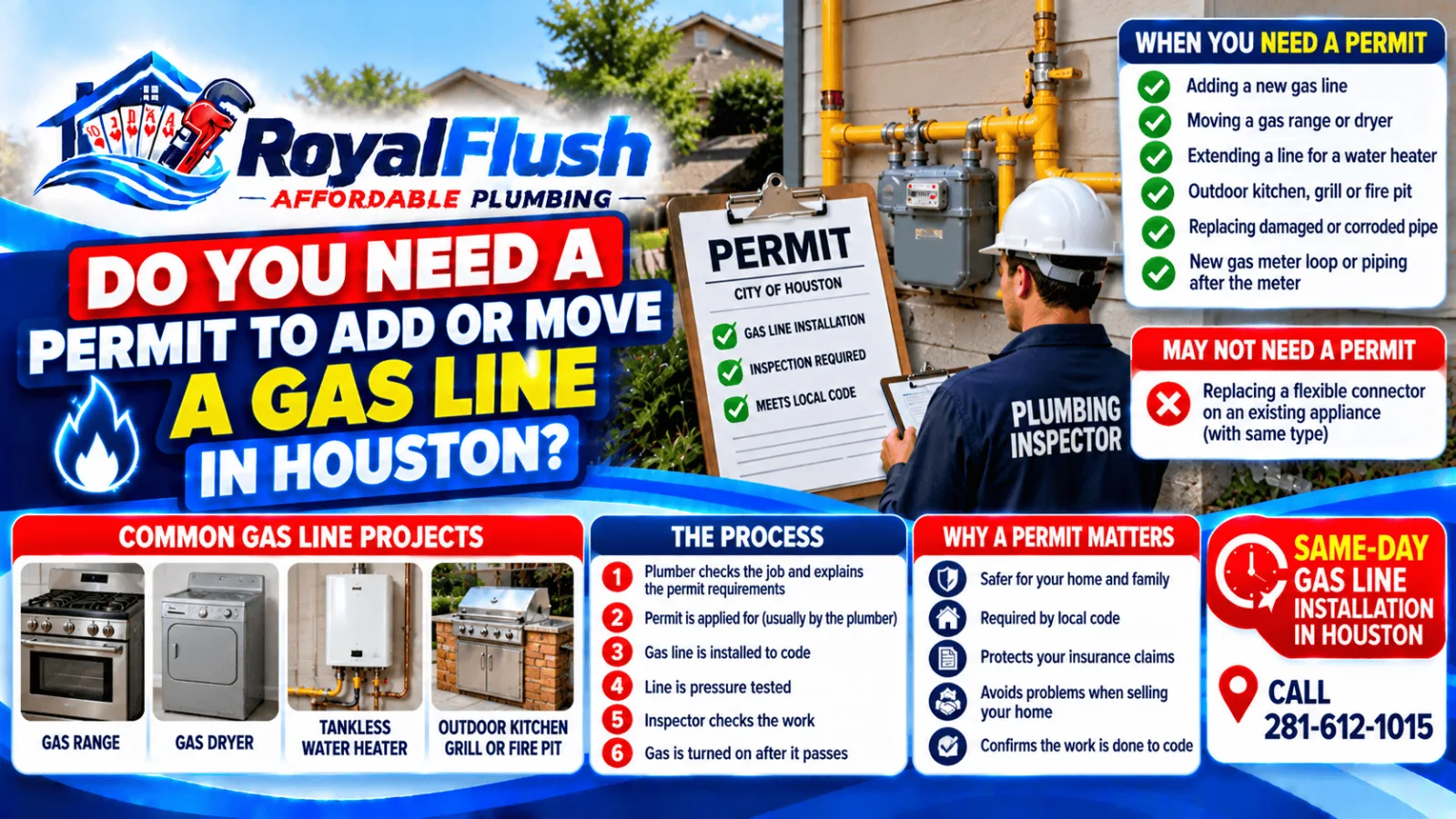
Ask five people whether a new gas line needs a permit and you will get five answers. The honest one is: usually yes, the details depend on where your house is, and the person to tell you for your address is the plumber who is going to do the work. This article explains how it normally works, so that you know what to ask and what to expect.
New or altered gas piping in the Houston area normally needs a plumbing permit and an inspection. The rules differ between the City of Houston, the surrounding cities and unincorporated county areas, so the exact steps depend on your address. The licensed plumber doing the work usually applies for the permit, the line is pressure tested, and an inspector checks it before it is put into service. Skipping the permit can cause trouble with insurance claims and when you sell the house.
- Adding, moving, extending or replacing gas piping is regulated work, not routine maintenance.
- The rules depend on the city or county where the property sits. Houston, the suburbs and unincorporated areas are not the same.
- A licensed plumber normally pulls the permit as part of the job. Ask about it before the work is scheduled.
- The inspection is not an extra charge for the plumber's benefit. It is the check that the line holds pressure and was built to code.
- An unpermitted gas line is a problem at the next sale, the next insurance claim and the next inspection.
What counts as a gas line job
Not every gas task needs a permit. The work that generally does is anything that adds to or changes the piping:
- Running a new line to a range, cooktop, dryer or fireplace
- Moving a range or dryer to a different wall, which means moving the supply
- Extending a line to a tankless water heater, which often needs a larger line
- Gas to an outdoor kitchen, grill, fire pit or generator
- Replacing a section of corroded or damaged pipe
- A new gas meter loop, or work on the piping after the meter
Replacing a flexible connector on an existing appliance with the same type, or reconnecting an appliance to the same valve, is generally treated as a repair rather than new piping. Whether a particular job needs a permit depends on the jurisdiction, so it is a fair question for any plumber to answer before they start.
Why the permit exists
A gas line that fails is a fire or explosion risk, and the failure is usually invisible until it matters. A joint that is nearly tight, a pipe that is the wrong size for the load, a line routed through a place where it can be damaged: none of these show up in a quick look. The permit and inspection process puts a second set of eyes on the work and requires a pressure test that proves the line holds.
For a homeowner it also produces a record. A permitted gas line is on file with the city or county. That record is what you show an insurance company after a claim, or a buyer's inspector at a sale.
Who pulls the permit
In most cases the licensed plumber who does the work applies for it. In Texas, plumbing work is done under a Responsible Master Plumber license, and the plumber who holds it or works under it is the one accountable for the work. Royal Flush Affordable Plumbing works under Texas Responsible Master Plumber License RMPL #42403, issued by the Texas State Board of Plumbing Examiners.
Some jurisdictions have rules about homeowners doing work on their own home, and those rules vary and change. Even where a homeowner may legally do some of it, gas is an unforgiving system to practice on. A leak at one joint is dangerous, and you will not find it by looking.
What the process looks like
The exact sequence depends on the city or county, but the pattern is similar nearly everywhere:
- The plumber looks at the job and tells you what will be done, what it will cost, and what the permit involves for your address.
- The permit is applied for before work begins, usually by the plumber.
- The line is installed. Piping, supports, shutoff valves and connectors, done to code.
- The line is pressure tested. Gas is not turned on. The pipe is filled with air at a test pressure and watched to see whether it holds. A drop in pressure means a leak somewhere.
- The inspector checks the work. Depending on the city, this may be at a rough-in stage before walls are closed, a final stage, or both. The inspector looks at the piping, the shutoffs, the test and the connections.
- The gas is turned on once the work has passed. In some cases the gas utility has to be involved before service is restored.
Plan for the inspection in your schedule. An inspector has to be available, and a failed inspection means a correction and another visit. A good plumber builds that into the timeline.
What happens if the permit is skipped
People skip permits to save time, money or the trouble of an inspection. The risks tend to show up later and cost more.
- At a sale. A buyer's inspector notices a gas line or an appliance that does not match the permit record, and the repair request lands on you.
- With an insurance claim. After a gas fire or leak, an insurer may ask who did the work and whether it was permitted. An unpermitted modification can complicate a claim.
- When the work is wrong. Without a test and an inspection, a leak or a wrong pipe size can sit unnoticed for years.
- With the city. In some places unpermitted work can be required to be opened up, corrected and inspected after the fact, at your cost.
What to ask a plumber before you hire
- Does this job need a permit at my address, and who pulls it?
- Is the permit included in the price you quoted, and are inspection fees?
- What stage will the inspection happen at, and who is there?
- Will the line be pressure tested before the gas goes on?
- Who will be here when the inspector comes?
- Can I get a copy of the permit and the final invoice?
A plumber who is reluctant to answer these is telling you something. Royal Flush Affordable Plumbing will tell you what applies at your address before the work is scheduled, and every job ends with a written work order and invoice.
Gas and a home sale
Gas piping comes up at inspection more often than most sellers expect. Common findings are appliances with no shutoff valve within reach, flexible connectors that are old or kinked, unsupported pipe, and lines that were added without a permit. If your inspection report has flagged any of these, see our page on plumbing repairs after a home inspection, which covers how we handle the items on a report.
Frequently asked questions
Do I need a permit to move my gas range or dryer to a different wall?
Usually yes, if the move means changing the gas piping, which it normally does. Reconnecting an appliance to the same valve with a new connector is a different matter. Ask a plumber, because the rules depend on your city or county.
Who is responsible for getting the permit, me or the plumber?
Normally the licensed plumber doing the work applies for it. Confirm that before you hire, and confirm whether the permit and inspection fees are in the quote.
How long does a gas line inspection take?
The visit itself is short, but you need an available inspector and the work has to be ready. Allow for scheduling, and for the chance that a correction is needed and a second visit is required. Your plumber can tell you what to expect in your area.
Is a pressure test the same as an inspection?
No. The plumber pressure tests the line to prove it holds before gas is turned on, and the inspector checks the work, often watching or requiring that test. They are two parts of one process.
Does the gas company need to be involved?
Sometimes. The utility looks after the line up to and including the meter. For work on your side of the meter it may need to turn the service back on after an inspection. Your plumber will tell you if that applies.
Can I skip the permit if I am just adding one line?
Adding a line is exactly the kind of work that normally needs one, however small it seems. A short line is still a pressurized fuel gas pipe. Ask the plumber, and avoid a contractor who tells you not to bother.


