Most outdoor kitchens are designed around the grill, the countertop and the view. The gas line is the part nobody draws on the plan, and it is the part that costs the most to change once the patio is poured. A line that is planned before the pavers go down is a simple job. A line added afterward means cutting, trenching and relaying finished work.
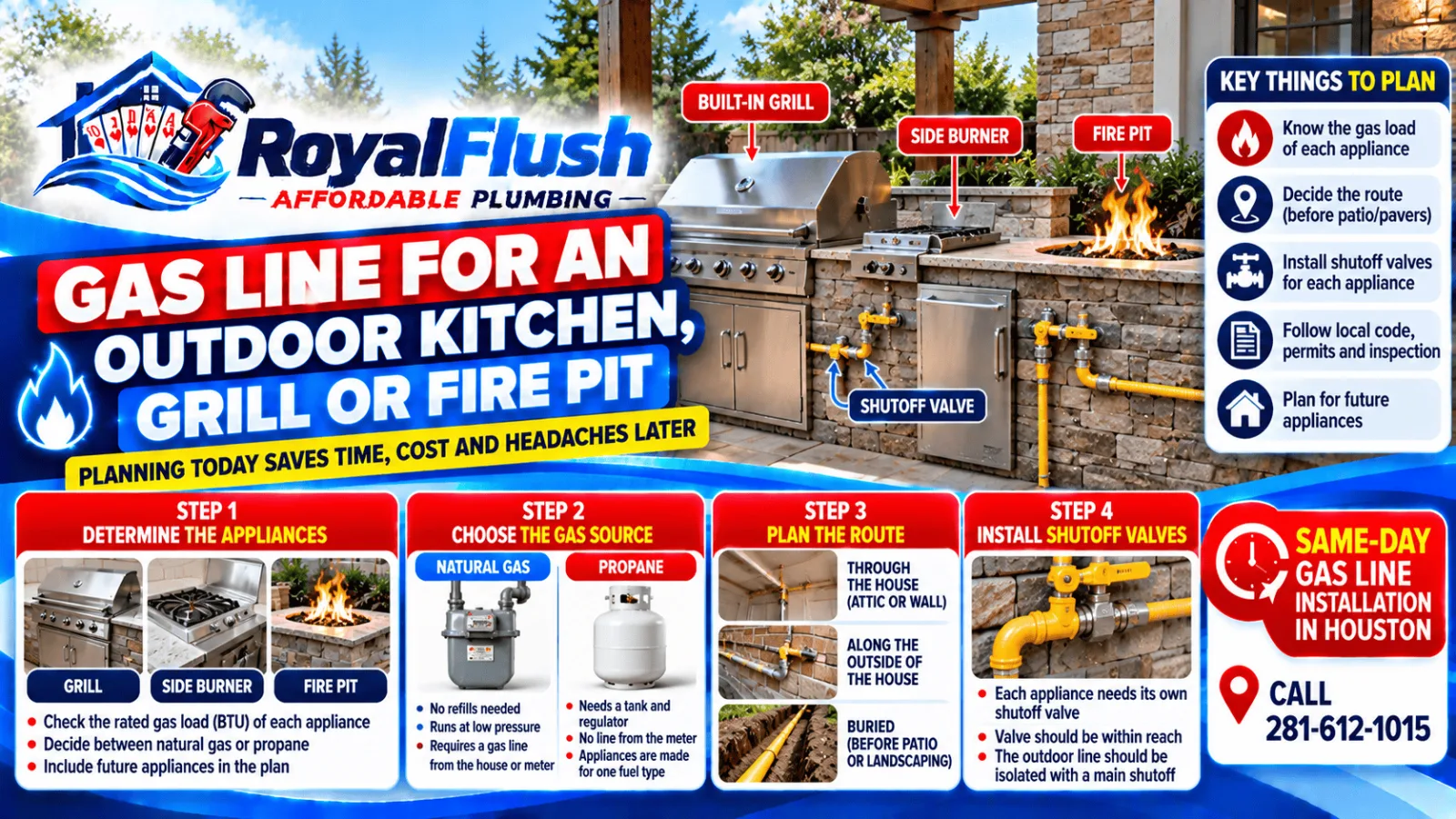
For an outdoor kitchen, built-in grill or fire pit, decide four things before construction: what each appliance burns (its rated load), where the gas supply will come from and how it will reach the spot, where the shutoff valve will be, and whether the line will be buried, surface-run or run through the structure. A licensed plumber sizes the pipe for the total load, runs the line before the patio, countertops and landscaping are finished, installs a shutoff, and pressure tests it. New or altered gas piping normally needs a permit and an inspection.
- Plan the gas line before the slab, pavers or countertops. This is the single biggest cost saver.
- Add up the load of every appliance, including future ones. Pipe sized for one grill will starve a grill, a side burner and a fire pit run together.
- A permanent line is not the same as a hose from the house. A hose is a stopgap, and it is not what the appliance manufacturers describe.
- Every appliance needs its own shutoff valve within reach, and the whole outdoor line needs a way to be isolated.
- Natural gas and propane are different systems with different rules. Know which one you are building before you buy appliances.
Step 1: Decide what burns what
Gas appliances are rated by the amount of gas they burn at full power, shown on the data plate or in the manual. A built-in grill, a side burner, a pizza oven, a fire pit and a patio heater each have a rating, and they add up. This number is what a plumber uses to size the pipe, and it is why a vague idea of "a grill and maybe a fire pit later" leads to a line that is too small.
Collect, before you talk to a plumber:
- The make and model of each appliance you intend to buy, or the manufacturer's spec sheet if you have not bought it yet
- Whether each is a natural gas model or a propane model, since the orifices and regulators differ
- A list of what you might add in three years, so that the pipe is sized for it now
If the appliance can be ordered as natural gas or propane, order it for the fuel you will use. Converting later is possible on some models and not on others, and it is a manufacturer-specified job.
Step 2: Natural gas or propane
Most homes in the Houston area have natural gas at the meter, which makes a permanent natural gas line to the yard the simplest answer. Propane uses a tank and a regulator, and its piping and tank placement fall under separate rules from natural gas. Our gas piping work is natural gas. If you have a propane setup, or want one, tell us when you call and we will say honestly whether we can help, or whether a propane specialist is the right call.
A few practical differences to keep in mind:
- Natural gas needs no refills and runs at low pressure, but it needs a pipe from the house or meter to the outdoor kitchen.
- Propane needs a tank to be filled, and the tank has to be placed and regulated correctly, but it needs no run from the meter.
- Appliances are made for one fuel or the other. A propane grill will not run correctly on natural gas without a conversion kit and the right orifices.
Step 3: Pick the route
The gas has to get from where it enters the house to the outdoor kitchen. The route decides the length of the pipe, which decides the size of the pipe and a large part of the price. There are three common routes:
- Through the house and out. A line from an existing gas point, such as the water heater or range, through an attic or wall and out to the patio. It is short and avoids digging, but it needs a clear path and is limited by what the existing line can carry.
- Along the outside of the house. A line run on the exterior wall from the meter or an existing connection, then to the outdoor kitchen. Exposed pipe has to be protected and supported, and it is visible, so it is worth planning around the look of the wall.
- Buried. A line from the house or meter underground to the outdoor kitchen. This is the neatest result, and it is the one that has to be done before the patio, pavers or landscaping are finished, because it needs a trench.
Which materials are used, how deep a buried line goes, how it is protected and marked, and where it may cross a slab are set by the local code and the type of pipe. We explain what applies to your address when we look at the job. The photo on this page shows what a trench for new pipe looks like before it is backfilled. Gas lines follow the same logic: dug once, laid correctly, tested, then covered.
Step 4: Shutoffs and where to put them
Every gas appliance needs its own shutoff valve, close enough to reach in an emergency and not hidden behind the appliance. On an outdoor kitchen that usually means a valve in the cabinet below the grill, one at the fire pit and, ideally, a single shutoff at the start of the outdoor line so the whole run can be isolated without turning off the gas to the house.
A shutoff placed inside a built-in cabinet needs an access panel. Think about it when the cabinet is designed. It is easy to design a beautiful island and discover afterward that nobody can reach the valve.
Step 5: Timing with the other trades
An outdoor kitchen involves several trades: the concrete or paver crew, the mason or cabinet builder, the electrician, and the plumber. The gas line is easiest to do at two points.
- Rough-in. Before the slab or paver base, the plumber installs the buried line and stubs it up where the appliance will go, caps it and pressure tests it. This is when trenches are cheap.
- Final connection. After the cabinets and appliances are in, the plumber makes the final connection, adds the shutoff and flexible connector, and does a leak check.
Skipping the first stage is the usual reason for an expensive gas line. If the patio is already poured, the line has to go around it, under it or through it.
Permits and inspections
New or altered gas piping normally needs a permit and an inspection from the city or county where the property is. The rules differ between Houston and the surrounding cities and counties, and between an unincorporated area and a city. A licensed plumber knows what applies at your address, and a gas line built without a permit can cause problems later at a sale or an insurance claim. When you call, ask what the permit involves before the work is scheduled.
What it should look like when finished
- Pipe and fittings suited to the location, supported and protected where they are exposed
- A shutoff at each appliance, and one that isolates the whole outdoor line
- A new flexible connector on each appliance, rated for it
- A pressure test of the finished line, and a leak check on each joint
- An explanation of where the shutoffs are and how to turn the gas off
- A written work order and invoice
Royal Flush Affordable Plumbing does this work under Texas Responsible Master Plumber License RMPL #42403. If the appliances are already in and need connecting, see our gas appliance hookup page.
Common mistakes
- Sizing the line for one appliance. The second and third appliances are what starve the first.
- Running a hose from the house to the grill as a permanent solution. It is a temporary connection, and it is not what a built-in installation is designed for.
- Burying the line without marking it or telling anyone. A buried line has to be known about the next time anyone digs. Keep the plan and a photo of the trench.
- Putting the shutoff behind the appliance. In an emergency you cannot reach it.
- Skipping the leak check after the appliance is connected. The line may be tight, and the connection may not be.
Frequently asked questions
Can I run a gas line to my outdoor kitchen myself?
Gas piping is regulated work, and in most places it needs a permit and an inspection. It is also a safety issue: an unsealed joint can leak without being noticed. A licensed plumber should do the piping, test it and arrange the inspection.
How big does the gas line need to be?
It depends on the total rated load of the appliances on the line and the distance from the supply. A plumber adds up the loads and sizes the pipe so each appliance gets what it needs at full power. A line sized for one grill will not run a grill, a side burner and a fire pit together.
Can I hook up a gas grill to the house gas line with a hose?
A quick-connect hose is sold for some portable grills, but a built-in outdoor kitchen is designed for a permanent supply with a shutoff valve. A hose across the patio is a stopgap and is not a substitute for a proper line.
Do I need to do the gas line before the patio?
You do not have to, but it is far cheaper if you do. A buried line needs a trench, and trenching across a finished patio means cutting it and relaying it. The best time to run the gas is before the slab, pavers or landscaping.
Natural gas or propane for an outdoor kitchen?
If you have natural gas at the house, a natural gas line is usually the simpler long-term answer, with no tanks to refill. Propane works where there is no natural gas, but it uses a tank and falls under different rules. Tell us what you have and we will say what we can do.
Does a gas fire pit need its own shutoff?
Yes. Like any gas appliance it needs a shutoff valve within reach, and the whole outdoor line should be able to be isolated. A fire pit often sits farther from the house, so its valve is worth planning at the design stage.