
Shopping for a tankless water heater turns up two unfamiliar words quickly: condensing and non-condensing. The salesperson says one is more efficient, and the price tag says it too. What nobody explains is what the difference means in your house: the vent pipe, the drain, the gas line and the attic. Those are the parts that decide the real cost.
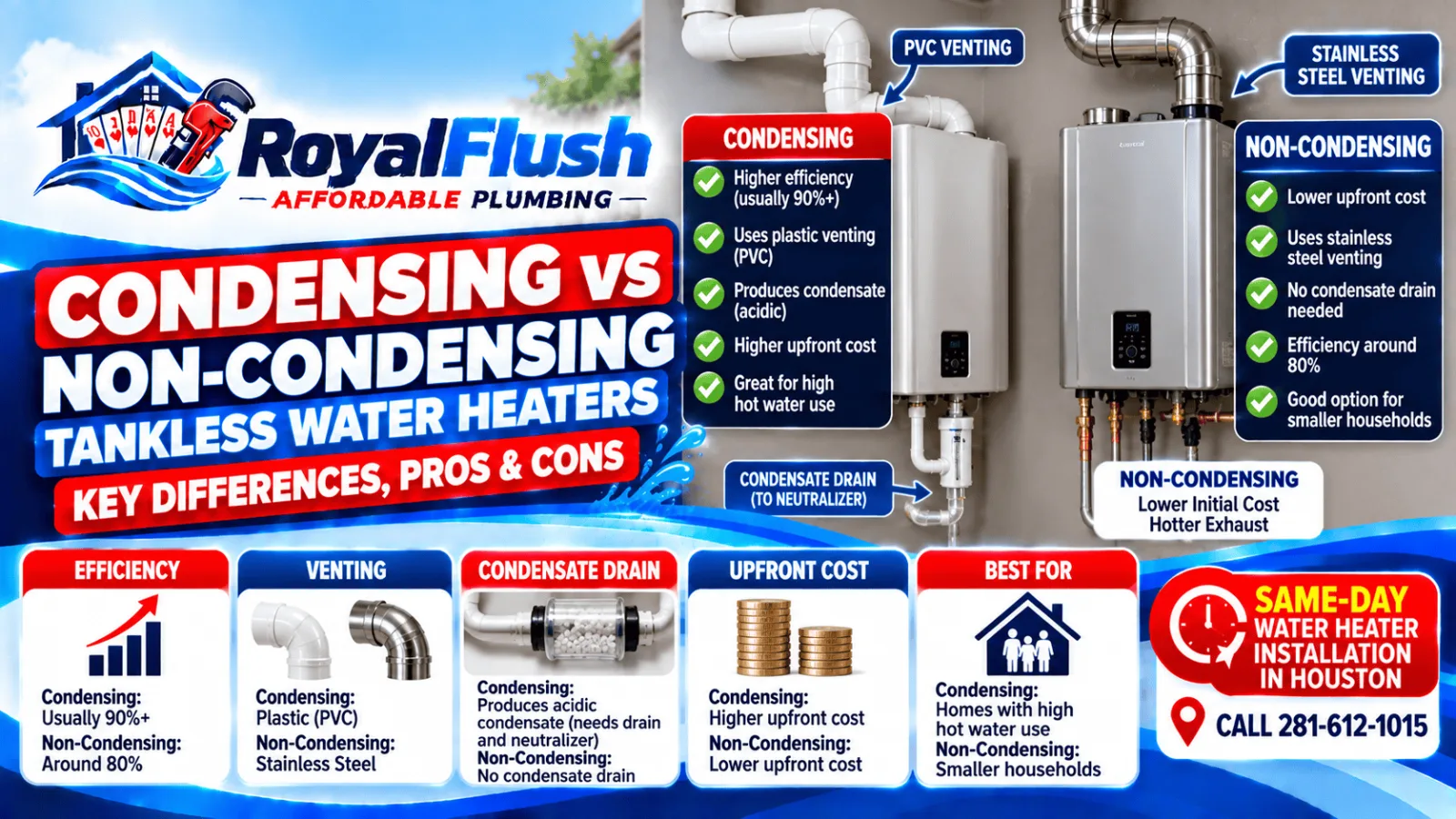
A condensing tankless water heater has a second heat exchanger that pulls extra heat out of the exhaust. It is more efficient, usually above 90 percent against about 80 percent for non-condensing, and its exhaust is cool enough to vent through plastic pipe. It also produces acidic condensate that must drain away. A non-condensing unit costs less to buy, vents hot exhaust through stainless steel pipe, and needs no condensate drain. Both burn gas, both need a correctly sized gas line, and both need regular maintenance.
- Condensing means more efficiency, plastic venting and a condensate drain. Non-condensing means a lower price, metal venting and no drain.
- The efficiency gap matters most in homes that use a lot of hot water. In a small household the difference in gas cost is small.
- Both types need a gas line big enough for the burner. The existing line is often too small for either.
- The installation location often decides the choice: where the vent can exit and where the condensate can drain.
- Houston's mild winters and warmer incoming water mean smaller savings than the national averages suggest.
What condensing actually means
Every gas water heater burns fuel and sends the hot exhaust out through a vent. A non-condensing tankless unit has one heat exchanger. The exhaust leaves quite hot, and a significant amount of the heat from the gas goes up the vent with it.
A condensing unit has a second heat exchanger in the exhaust path. The exhaust runs over it, gives up much of its remaining heat to the incoming water, and cools enough that the water vapor in it condenses into liquid. That is the "condensing". The cooled exhaust leaves through the vent, and the liquid condensate drains out.
Two practical consequences follow, and both are visible in the house:
- The exhaust is cool. It can be vented through plastic pipe, usually PVC or a similar approved material, which is cheaper and easier to run than stainless steel.
- There is a condensate. The liquid is slightly acidic. It has to be drained to a suitable place, and in many installations it is routed through a neutralizer first.
Efficiency: the numbers in plain terms
Efficiency is the share of the energy in the gas that ends up as hot water. Non-condensing tankless units are generally around the low 80 percent range. Condensing units are generally above 90 percent. Tank water heaters sit lower than both. The exact figures are on the unit's rating label and the manufacturer's specification sheet, and are worth checking for any specific model.
What that gap means in dollars depends on how much hot water you use and what you pay for gas. A rough way to think about it: a small household with a few showers a day has a small gas bill for water heating to begin with, so a gap of ten percentage points saves a small sum per month. A large household, or one with heavy laundry and a lot of baths, saves more.
Houston adds a regional wrinkle. The efficiency savings in national marketing are often calculated against colder climates, where the incoming water is much colder and the heater works harder. Here the water arrives warmer and winters are short, so the gap in real running cost is smaller than the brochure suggests. It is still real, and over a long life the more efficient unit can recover its higher price, but it is not a guarantee, and for a small household it may not.
Venting: the difference you can see
This is the part that most often decides the choice.
- Non-condensing units produce hot exhaust. They need stainless steel or similar vent pipe made for high temperature, with sealed joints and correct clearances to anything that burns. Stainless vent pipe is more expensive and stiffer to route.
- Condensing units produce cool exhaust and can use plastic vent pipe. It is cheaper, lighter and easier to run through an attic or a wall. It also has to slope back toward the unit so that condensate does not pool in the vent.
In both cases the vent has to terminate outdoors, at a legal distance from windows, doors and air intakes. In an attic installation that often means a run through the roof or an outside wall, and the route is a large part of the labor.
The condensate drain
A non-condensing unit has no condensate to deal with. A condensing unit does, and it has to go somewhere. In an attic installation, the options are a nearby drain line, a floor drain, a laundry standpipe or a pump that carries it to one. The condensate is acidic enough that it should not run onto a roof, a floor or into a metal drain without treatment. A small neutralizer cartridge, filled with a material that raises its pH, is the standard answer and needs checking from time to time.
If there is no convenient drain, a condensate pump adds a part that can fail. It is not a reason to rule out a condensing unit, but it is a reason to plan for it.
The gas line: the part people forget
A tankless heater burns a lot of gas at once. A typical tank heater burns a modest amount for a long period. A tankless unit sized for a whole house burns several times as much for as long as water is running. The gas line that fed the old tank heater is often too small for it.
That applies to both types. It is one of the main reasons an installation costs more than the price of the unit. A plumber sizes the gas line from the unit's rating, the length of the run, and the other appliances on the same line, and upgrades it if needed. If you want to read more, see our gas line installation page, which explains how the line is sized and tested. Every tankless install should end with a pressure-tested gas connection, a shutoff valve within reach and a new flexible connector.
Cost: what is really different
Without quoting prices, here is where the money differs between the two.
- The unit. Condensing units generally cost more to buy.
- Venting. Plastic is cheaper than stainless, so the condensing vent can cost less. A long or complicated route reduces the saving.
- Condensate drain and neutralizer. An extra cost for condensing only, usually small.
- Gas line. The same issue for both. It depends on the distance and the size.
- Running cost. Lower for condensing, with the size of the gap depending on how much hot water you use.
- Maintenance. Both need an annual service and descaling in hard water areas. Condensing units add the neutralizer check.
Often the total installed price ends up closer than the equipment prices suggest. When one is notably cheaper to install, it is usually because of where the vent and drain can go.
So which one for a Houston home
- A larger household with high hot water use and a long time in the home: a condensing unit usually makes sense, as the efficiency gains accumulate and a drain is available.
- A small household, a rental or a home you may sell soon: a non-condensing unit is often the better value, because the extra efficiency takes longer to repay.
- An attic with no practical drain, or a long vent route: let the installation constraints decide. A non-condensing unit with a stainless vent can be simpler than a condensing unit with a pump and a drain.
- A replacement for a tank heater in a closet: check whether the closet has the vent route and clearance either type needs. Sometimes the answer is a different location.
- Hard water: both types scale up inside the heat exchanger. If your water is hard, plan to flush the unit regularly, and consider a softener. See our water softener installation page.
Whichever you choose, the result depends on the installation. A good one has a correctly sized and tested gas line, a vent that terminates properly, a condensate drain where needed, a drain pan, isolation valves for flushing, and a new connector. It is done under a Texas plumbing license, and Royal Flush Affordable Plumbing works under Texas Responsible Master Plumber License RMPL #42403. If your current unit is already installed and failing, see tankless water heater repair.
Frequently asked questions
Is a condensing tankless water heater worth the extra cost?
It depends on how much hot water you use and how long you will stay. For a large household in the home for many years, the efficiency usually repays the higher price. For a small household or a home you may sell soon, a non-condensing unit is often the better value. The installation details can tip it either way.
Can I replace a non-condensing tankless with a condensing one?
Often yes, but the vent and drain change. A condensing unit uses plastic vent pipe and needs a condensate drain, so the old stainless vent usually comes out and the drain has to be arranged. Check the vent route and the drain location before you buy.
Do condensing tankless heaters need a drain?
Yes. The condensate has to drain, usually through a neutralizer first because it is slightly acidic. A nearby drain, a standpipe or a condensate pump is needed. Non-condensing units do not produce condensate.
Will a tankless water heater work with my existing gas line?
Sometimes, but often the line is too small. A tankless unit burns far more gas at once than a tank heater, so the line is sized from the unit's rating and the length of the run. A plumber checks it before the unit is ordered.
How often does a tankless water heater need maintenance?
Most manufacturers recommend an annual service and a flush to remove scale, more often in hard water. Condensing units also need the neutralizer checked. Skipping the flush is one of the most common reasons a tankless unit fails early.
Can I put a tankless water heater in the attic?
Yes, many Houston installations are in attics. The unit needs a drain pan, a vent route to the outside, a safe gas connection and access for service. A plumber can tell you whether your attic has what it needs.


